SEO Content Strategy: The Importance of Personas

There are many components of Search Engine Optimization (SEO), from keyword selection to technical optimization to the way you approach content as a whole. While it was once sufficient to simply stuff a bunch of keywords onto a page and show up well-ranked for those terms, those days are long gone.

Quality and Relevance Are Even More Important than Ever

The Panda / Farmer update introduced quality as a key metric, and it is measured through a rather complicated algorithm. This algorithm reviews the word count, the style, the grammatical correctness, and the type of website it is. Then, it factors in how it ranks sites that it deems “similar”, and assigns a ranking factor there as well. There are no “tricks” to get around this one. Just write good content with correct spelling and grammar, in natural language that a real reader would understand.

Relevance also influences this algorithm, albeit indirectly. Panda incorporates metrics that indicate how readers respond to the content (bounce rate, time on page/site, pageviews / visit, etc. – all readily available via Google Analytics or any leading commercial analytics package). This is a GREAT development for those of us who practice white hat SEO exclusively. Write for your audience, keep them engaged, include keywords that your readers will relate to, and the rankings will come over time.

How to Manage Relevance

The first requirement is clearly to understand  your space. Keep up with the latest trends, jargon, technologies, events, thought leaders, and social “buzz” to start. If you have been in the same industry for several years, you likely already have this covered.

The second, and most commonly overlooked, requirement is to develop good user personas. For those of you who are unfamiliar with the concept, here is my definition of the term as it relates to web content:

A persona is a fictional character that describes your target audience or a segment of your target audience, whichever is most practical for making rational splits in content, tone, and approach.

So basically, a persona is “Joe Customer” or “Jane Prospect”. It is outlined in prose format, often reading like a brief biography of the fictional person. Many companies go so far as to give the persona a name, age, job title, and even a photo. The idea is to get buy-in across your leadership team as to exactly who you are writing for. To know them, their story, what motivates them, what their hobbies are, whatever it is about them that you think you should message to.

Check out some sample personas on the following websites for reference:

Some marketing and IT  types (personas are also useful for Software Interface Design and Usability) are skeptical about this idea. They claim to already know their audience. Some call this a silly exercise. And really, it may not be necessary to document each individual persona…in one situation: where you already know the persona intimately, and you ( and ONLY you) will be involved in generating content for that audience. If you write content for a business with more than five employees, there is a place for user personas.

How to Apply Personas to Content

The first step to moving the needle with personas is to get buy in from the most important decision makers in your organization. We’ve seen far too many persona efforts scrapped mid-way because leadership was not included early enough. It is crucial that those decision makers start to really envision the fictional character to whom you will be messaging. Once you are all on the same page, you will get a lot less pushback later once you turn persona into messaging and finished content.

Next, review your customer lifecycle in more detail. Do you already have content for all the key pre-sales stages in the life cycle? Specifically, you should have:

  1. Thought leadership materials that educate (not pitch) the customer on important trending topics in your space? Complete with calls-to-action that drive them to your website for potential conversion
  2. More in-depth content about the technology, technique, service, or product type you sell, and even deeper content about your own products or services
  3. Very focused differentiation and validation materials, such as why you are best, case studies, third party reports, and testimonials
  4. A very clear path to purchasing once they are ready to do so

Now you are ready to take action. Look at each persona and start listing the types of materials they might like to see at each of these points in the life cycle. Look for where there are overlaps and differences, because overlaps are opportunities to write content once, and use it for multiple audiences. Then prioritize based on two factors:

  1. Relative importance to your business or cause for each persona
  2. Areas where you can provide relevant content to multiple personas with the same information or very similar content

Once you complete this exercise, you should have a reasonable start on the content plan to improve your analytics and relevance in tandem.

Summary

User personas are a key component of any content strategy that places relevance at the top of the priority list. With Google Panda now measuring relevance, you really have no choice but to pay attention to this topic. Take time now to be sure you know who your target audience is personally, and enjoy the SEO and increased traffic it will offer to you under the new ranking algorithm.

Have you ever been involved in user persona creation? What worked and didn’t work? Do you have any samples that would help our readers better understand this?

Please share your experiences, successes, failures, and samples in the comments section below!

Google Search vs. Display – Pros and Cons

This week, PPC expert Matt Kelly shares his guidance about when to use Google AdWords and when to focus on the content / display network.

____________________

Search vs. Display: What Are They?

In Google Adwords, there are two primary “venues” on which you can display ads, the first being Google Search, the second being the Google Display Network (GDN).

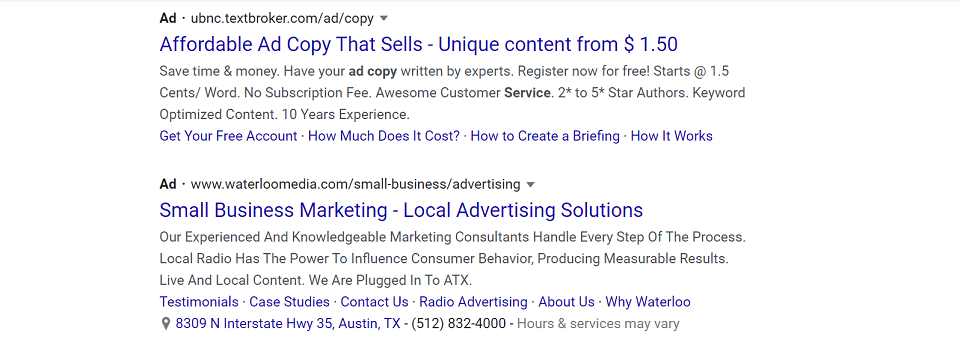
Google Search and their search partners, such as search.aol.com, allow the display of text  ads along with organic results (unpaid) that are triggered by keywords. You type in a keyword or phrase, Google displays the most relevant ads.  When you click on the ad, the advertiser is charged based on an auction price and you are re-directed to the advertiser’s website.

GDN on the other hand are “contextually” targeted ads based on content, interests, or topics. Publishers of content use Google Adsense as the vehicle for displaying ads. In addition, Google uses your demographic data and interests to display ads you might be interested in.

You can view your Ad Preferences at: http://www.google.com/ads/preferences/

So if, for example, you are reading an article about Tiger Woods skipping the US Open and see an ad for the new Nike 20XI golf ball, the ad is there.  Nike recognizes that, if you are reading an article on golfchannel.com, you probably have an interest in Golf. So you might buy golf balls.

On the other hand, if you are reading an article on nytimes.com, you might see the same Nike 20XI Golf ball ad.  Most likely, this ad was displayed because your Ad Preferences indicate “Golf” as an interest.

How to Find a Good Site Where You Can Advertise

There are a variety of ways to find relevant/high quality sites to target.  Generally speaking, I look for them in this order:

  1. Search Google using the most valuable keywords I am trying to target.  I prefer using Google Search initially to find sites to advertise on, since those that show up on the first page are presumably more relevant. From the organic search results, I look at the websites on page one to see if they are running ads from either Google or Double Click. I also check the depth and content of the site for quality. If you see display ads on the site, check the link of the ad by either hovering over it, or look for the “Ads by Google” logo. (Hint: If you are a publisher, invest in SEO so we can find your site. [Double Hint from editorial team: Return On Now can help you])
  2. Next step is to use the Google Adplanner.  Adplanner allows me to more specifically target websites running Adsense based on audience parameters such as geography, language, demographics, online activity, and interests.  Adplanner also provides filtering based on Google Ranking method, inventory, category, ad specific, and domain suffix.
  3. I’ll use the “Placement Tool” in Adwords, even though the results are typically comparable to those found in Adplanner.
  4. I look at the sites referring traffic in Google Analytics to find sites that are sending some traffic, but would be good prospect for sending more.

From the research above, I will add sites as “Managed Placements,” in addition to a list of standard sites I always target such as mail.google.com, ehow.com, about.com. and nytimes.com

Managed placements are my highest value group of websites, as opposed to automatic placements, which are those that Google is determining as relevant and then displaying my ads accordingly.

Think of the difference between Automatic and Managed placements as if they were baseball teams.  Managed placements are the players on the team that have made it to a Major League Team. I hand picked them, and if they don’t play well, I kick them off them team. In the past, they have performed well and are of above average quality.

Automatic placements are those that are still in the farm system working extremely hard to perform well enough to make it to the Major League. Automatic placements, like a Baseball Scout,  are also always on the lookout for new sites to target or new players to add to the team.

Search Pros

  1. Simple to set up and manage

Search Cons

  1. It’s the first thing everyone thinks of when launching a paid search campaign, so the competition for a keyword may be high resulting in poor ROI / Return-on-Investment.
  2. In order to have an effective search campaign, a large amount of emphasis needs to be on targeting high Quality Score keywords
  3. It is available as “Cost-Per-Click” Pricing Only (also referred to as PPC / Pay-per-click pricing)
  4. Text ads are the only format allowed

Display Pros

  1. Lower Cost per click and conversion. On average the CPC is 30% less for display than search.
  2. Remarketing – This is the practice of displaying an ads on GDN  to someone that visited a particular page on your web site
  3. Measuring “view-through-conversion”, which is a metric of the number of conversions that happened within 30 days of someone seeing the ad
  4. Casts a much wider net (better reach) across content that is related to your keywords
  5. Pricing flexibility: Cost per Click or Cost per thousand (CPM pricing)
  6. Better targeting to content-rich and relevant sites
  7. More visually appealing ad options rather than just text
  8. Behavioral, demographic, and geographic targeting capabilities

Display Cons

  1. Getting your boss or client to understand why such a low Click Through Rate (CTR) is a good thing can be challenging
  2. Initial set up is more complicated that search
  3. Initial cost to set up is higher than search as you may incur a cost for advertisement design
  4. Less control can mean lower quality traffic if you are using automatic placement. Automatic placements require increased maintenance to exclude sites that are of poor quality (i.e. one page websites running Adsense on what is essentially nothing more than a doorway page)

So how do you sell this to your metrics-driven Boss or Client?

First, focus on what the key metrics are as follows:

  • Impressions:  Depending on a number of factors, including your overall budget and how much of it is allocated to display, you can see 10-20 times as many impressions as you can in search
  • Cost per click: As a general rule of thumb, your cost per click on display should be 30% less than Search
  • Cost per conversion:  The metric I personally manage to for display conversions is 20% less than search

Search Engine Marketing: PPC vs. GDN Metrics

If you are a newbie to display advertising, here is where to start:

  • Have five non-animated banner ads designed. The sizes I recommend are 300×250, 160×600, 200×200, 468×60, and 728×90. You should be able to get a decent graphics designer to design these ads for less than $400. The GDN ad specs are located at: http://adwords.google.com/support/aw/bin/static.py?hl=en&topic=28431&guide=28427&page=guide.cs
  • Create a separate campaign for “Managed Placements.” This will allow you to control the budget separately from search campaigns.
  • Limit that campaign to one of your ad groups so that you are testing a small group of keywords and phrases.
  • Allocate a small amount of your search budget to managed placements. I’d start with 10%.
  • Only use a handful of managed placements, i.e. less than ten. Make sure mail.google.com is on that list.
  • Cap your CPC at 30% less than your search CPC.

The biggest advantage of display versus search is it’s reach and the ability to give a product context through the use of images. As they say, “A picture is worth a thousand words”. So maybe a text ad is worth only one hundred words?

Think beyond just Search.

An SEO Experiment Gone Awry (Mea Culpa)

Today I am writing the most difficult blog post I’ve ever authored. Why so difficult? Because something I did has made some people very unhappy. So here I will state my case and lay myself before the mercy of the jury. I do not know if it will help, but at least the information will be available for any and all to read.

For those of you who know me personally, you can attest to the fact that everything I do is on the “up and up”. I’ve been called honest to a fault on numerous occasions. I value my reputation like I value those I love and cherish. In the spirit of honesty and transparency, I present the following.

Google Panda and an SEO Experiment

Several months ago, I first learned that Google was working on a algorithm update that was meant to penalize low quality and duplicate content online (now known as “Panda“). Needless to say, I was intrigued. As an SEO and online marketing practitioner professionally, I had witnessed sites like eHow manage to leap to the top of the rankings for nearly any search term you might enter into Google. On the other hand, I had syndicated blog posts from friends and colleagues here on Return On Now… content that would now be considered “duplicate” by Google. I was worried my SEO would take a negative impact, so I kicked off an experiment to test just how hard the update would affect me.

Structuring the Experiment

To perform an SEO experiment, you need content. In this case, I needed duplicate content. But I wanted to see just how aggressively Panda would penalize it. So I decided to design two test sites, one with essentially all duplicate content, and another with a handful of original pages plus some duplicate content as well. Since this was to be a short term trial, I built two WordPress sites using freely available standard templates and found a plugin that let’s you create posts from RSS feeds. Bingo! My experiment was ready to go.

Then I started thinking about what topic areas might be rich with RSS feeds to run the experiment.

I had already purchased “supplymyhobby.com” for an etail business idea I kicked around in 2010, and it was sitting there unused, so I chose it for the first site. Obviously, hobby content is widely available on the web, so I decided to make it the “all duplicate” site.

I also selected a new domain focused on back pain, an ailment I’ve suffered from since a car accident in 1994. I figured, since I am in the demographic of who would want to read this sort of content, I could hack together several pages of original content to supplement the duplicate material. In this way, I could test whether Google Panda would “slap” a site harder based on how much of the content is duplicate.

On both sites, I wanted to be sure Google indexed them as real sites and not experiments, so I did add some more promotional content. One asked for what hobbies readers want to see on the site. The other had a few pages of product reviews for back relief remedies.

Populating the sites

I built both sites first, and then configured the autoposting plugin. At this point, I actually had second thoughts and nearly scrapped the whole idea, but I figured that this was a short-term trial. I could set it up, get the sites live, ensure they are indexed in Google, and then watch the traffic trends until a few weeks after the Panda rollout. Then I could draw conclusions, turn it off, and integrate the learnings into my ongoing SEO work. The key phrase here is “turn it off”, which is where it gets hairy.

Now, I understand the slippery slope of using content from other blogs, There have been many debates about what a copyright means online vs. in print, what rights authors have, and what attributions are required for copied/shared content. As you’ve seen here on RON many times, I frown heavily upon stealing content for personal gain or other financial reasons. I would never, ever steal someone else’s high quality content for the sole purpose of taking credit for it or making money in a shady fashion. This is an important point, and one I will come back to shortly.

To get the sites indexed in Google, I had to connect it to some RSS feeds. Since I needed to get the site live as fast as possible to build a little momentum pre-Panda, I hurried to connect some RSS feeds that were serving up quality on-topic content and turned the sites on. I also set the content autoposting plugin to append two things on each post, the official name of the source blog and a link to the original content. I figured, at least I’m establishing backlinks which wouldn’t have hurt the original sites in any way pre-Panda, and I’m being upfront about what sites actually created the content. I did this because I am no content thief, and I would never do such a thing otherwise.

In this process, I did overlook one important thing on the WP template – I didn’t change it at all. That was an outright mistake, because they came with verbiage claiming that all material on the site was copyrighted by the site itself. Shame on me for the oversight, because I knew full well that some or all of the content would be written by others on their own sites. It has been suggested that I should have simply asked for permission, and I can’t argue that point. In my haste to make the experiment happen, thinking no one would even notice, I did not do so. Again, shame on me.

Once the sites were live, I did not promote them aggressively. Upon launch, I did link to them from another website or two, ping Google directly, and bookmark a handful of pages and posts. Basically, just enough to get them indexed. My goal was not to build traffic, grow the sites, or create some sort of business. It was purely academic, and once indexed, only organic search traffic needed be measured to draw any conclusions.

Drawing Conclusions

Let’s keep this part short. What did I learn about Google Panda in this experiment?

  1. As we saw across a variety of sites, the penalty for duplicate content was swift and severe. Traffic essentially fell off a cliff back in February when it went live.
  2. There was a marked difference in negative impact between the two sites. The faucet was nearly turned off completely on the hobby site, while it merely took a downturn of >50% on the other site.

The second observation was especially enlightening, because it showed that Google weights its rankings according to amount of duplicate content, not an across-the-board slap for having any of it. This is exactly what I was hoping to see, because now I don’t have to worry about my organic traffic completely drying up on Return On Now.

Great, experiment over. Back to business….Not so fast buddy.

Finish What You Start

I made a crucial mistake at that time. I neglected to turn off the sites as planned.

I could spew a littany of excuses including adding a new client for my SEO business, rolling out a major new website for a local tech company, and having to deal with some personal stuff that distracted me elsewhere.

But bottom line: the sites lived on.

Earlier this week, a Google Alert came to my In-Box that really caught my attention. One of the bloggers whose content I used in the experiment (In Stitches) had seen SupplyMyHobby and was rightfully upset. I knew immediately that leaving up the site had backfired, and that I now had created a mess for myself. The old adage “finish what you started” came to mind, and I realized I had completely dropped the ball.

You see, In Stitches is a GREAT blog. They have a good quorum of regular participants on the blog, and the author (Pam MacKenzie) has built a wonderful online presence within the knitting community. I respect her work with the highest regard, which is part of the reason I used the content in the first place. I feel the same way about every one of the blogs that populated SMH during this experiment.

Immediate Remediation

This Google Alert pushed me to immediate action. After reading her scathing blog posts directly, seeing words such as “plagiarize” and “stealing”, I immediately opened my hosting FTP account and deleted the two sites completely. Of course, this was over 2 months too late, but I removed them from the web without delay and also deleted the Google Analytics accounts I used to track the experiment. I wanted no semblance of these websites to remain live online for any reason.

As I mentioned earlier, I am 100% dedicated to honesty, transparency, and taking responsibility for my own actions. The next step I took was to send an email directly to Pam with a full apology and an attempt to explain what I was doing. But you can only say so much in an email, which is why I am posting this live on my REAL blog for the whole world to see. Nothing to hide here.

Picking Up the Pieces

Ms. MacKenzie continues to think I am a scammer.

While I can understand why she might think so, I implore you to take this into account – if I were actually stealing content and taking credit for it, why in the world would I have attached it to a hosting account that lists my real name? Just search for me online and you’ll get a whole page of links to my various blogs and social media profiles. I bare myself to the world in full color, without editing or filtering. I am who you see online, in person, and in writing.

It’s known that scammers make up fake IDs, names, and contact information so that you can never actually trace their footprints. Do the math for yourself, and you’ll see that this is a severe misunderstanding that blew up in my face in the worst way possible.

I screwed up, and I apologize from the bottom of my heart to every one of the bloggers whose work I used in my experiment without asking for advanced permission. It was wrong, and I’m done fielding isolated SEO experiments altogether. It’s far too risky to touch again.

Lesson learned. I hope you can understand. Namaste.

Enhanced by Zemanta

Privacy and Social Media: Something is Amiss

Privacy has been a sizzling hot topic for social media users over the past couple of years. The various services and websites have all taken unique approaches to privacy, some catering more to the users, and others taking liberties to leave doors open for future business and revenue opportunities.

This week, two separate topics came to my attention, both related to privacy, and I absolutely felt it necessary to share and comment here on Return On Now.

Careful Who You “Friend”

Breaking news from Raw Story this week reported that the federal government has had “persona” software commissioned. This software is to be used for “classified social media activities.” Essentially, this software can allow a user / company / government to create small (or large) armies of “virtual personas”. To top it off, these virtual personas are not only generated, but built out with additional information like life/work/education history, and even faux geo-location information such as physical check-ins on location based services.

Now, I’m not one to throw stones before understanding the full story, but doesn’t this sound a bit concerning to you? Specific issues I have with this:

  1. This is an outright violation of privacy when used to collect information about social media users.
  2. Since social media is heavily influenced by activity, buzz, viral sharing, etc., this opens a door to manipulation of public opinion and even the very messages to which we are exposed.
  3. It’s just plain deceptive! [Y'know, the kind of stuff that would've resulted in detention in our school days.]

As concerning as this may be, we really have no way to respond except for using common sense. Don’t say anything on social media that you wouldn’t announce publicly. Exhibit control when reacting to emotional topics. And most importantly of all, only accept friend requests from people you actually know.

Facebook Friend Request from Barley Jang

Just this week, I got a friend request on Facebook from someone named Barley Jang. I’ve never heard of the name, they have no photo to show me who they are, and we have no friends in common…not a single one! In fact, after seeing the above article and receiving this request, Ms. Jang (or faux person extraordinaire, perhaps?) served as inspiration for this blog post. So at least there’s that.

But I’m still clicking “Not Now” on that one just to be safe. [Barley, if you are a real person, please reach out to me directly and I will happily eat my words.]

Petition to Google and Facebook

You may or may not be familiar with a group called Demand Progress, but you should most certainly be aware of their current hot button. Basically, Demand Progress runs online campaigns to raise awareness of what is going on in the “back room” of Congress, and helps the public get a voice in such activities.

Their current campaign is aimed at Google and Facebook. According to the website, both companies hand over personal data to the federal government for any legal request, but without ever even notifying the user of the request in the first place!

If you recall, Twitter stood firm about not revealing user information when the WikiLeaks fiasco came to a head. What did they do? After receiving the request, Twitter first contacted the users to notify them of it. Regardless of how the situation turns out, Julian Assange and the whole team at WikiLeaks had a fair chance to challenge the request before the data was handed over.

Don’t you want the same thing for your own personal data? It’s not about guilty or innocent, it’s about personal rights.

If you want to have your voice heard, sign the petition on the Demand Progress website today.

Enhanced by Zemanta

Bid Management vs. Budget-Based SEM Platforms

This week we bring to you another quality guest post, courtesy of my friend and colleague Gary Walker of Topside Media. I’ve already outlined my thoughts about Gary in a previous post, so I’ll leave it at that.

The following is actually an excerpt from a post he authored back in November. This hits on the high points of the original post. Thanks again to Gary for sharing his excellent work with Return On Now.

_________________________________

In today’s post, I’m going to briefly compare and contrast two types of automated platforms: bid management platforms and budget based platforms. We’re going to stick to how they work and what they do (and don’t do), and [we will] avoid using company names [in the process].

What a bid management platform does

At the most basic level, a bid management platform helps automate bidding and some routine optimization and reporting tasks across multiple pay-per-click (PPC) advertising platforms. Think of these as tools that can help a person who already knows how search engine advertising works do it faster and save time on creating reports. While they can save time on routine tasks and reporting, however, bid management platforms do not perform the most complicated, but essential tasks: design robust campaigns and ad groups that align user intent with your company offering, write multiple versions of text ads, analyze and help fix conversion issues with your website, etc.

Further, some of these platforms will take a sizable bite out your budget, and require up to 5% of total spend every month just for using their online tool.

What a budget-based platform is all about

In contrast, on a budget-based platform, you tell the sales rep for the platform (or the many companies that use a private-label platform) how much money/budget you have to spend. This number is then plugged into your business category in their automated platform, and it combines traffic from multiple sources. At the end of the reporting period, you look back to see how many clicks, “web events”, phone calls, or other metrics you got in return for your money. From our point of view, a lot gets sacrificed so that this can be automated. Just one example of features lost: many of the custom geo-targeting features from Google AdWords.

Transparency, or lack of it

In bid management platforms, the cost to the search engine and the cost to the provider of the bid management tool is usually transparent.

In budget-based platforms, you are unlikely to know what percentage of your budget is spent on traffic and how much goes to commission or fees. Generally, though, the bite is a major one. Further, it may not be easy or even possible to determine how much traffic was search traffic, vs. how much was contextual or other types of traffic.

Some would argue that the results, i.e. how many calls or conversions and the associated cost, matter the most. To some extent, we agree with that point, as long as the numbers are the right ones, and they are in fact real. For example, it is also important to know how many clicks, calls, and emails come from the use of your company name as a keyword. Another key metric that is not easy to get is quality of incoming phone calls: how to filter out repeat calls, how many lasted more than one minute, etc.

(Note: if the two examples make it seem like we are splitting hairs, take a deeper look — results from your company name, duplicate calls, and short calls can each be 20% or more of the total.)

Use Automation Wisely

In reading this, you might assume that I am against automation. Far from it. I’m all for automation, so long as it [reduces] work or cost and does not compromise much quality of the process or results. For example, at TopSide, we recently automated two processes that, when done manually, take too much time and do not deliver added value to clients:

  1. Rather than manually testing the websites we advertise (to make sure pages load quickly), we now automatically “ping” these sites at more frequent intervals.
  2. We now have a reporting dashboard that automatically summarizes click, conversion, and other data from the search engines with data from our phone call tracking system.

Although these tools initially cost quite a bit to build, using them helps our clients, and it helps us too.

_________________________________

If you would like to contact Gary directly to learn more about this topic or inquire about his services, contact Topside Media directly at 512-469-9935, or toll-free at 866-516-2301.

Enhanced by Zemanta

Are The Yellow Pages Obsolete?

Yellow Pages: This Dinosaur Is About To Be Extinct

Yellow Pages: This Dinosaur Is About To Be Extinct

Following on my previous post, Local Services Businesses: Why You MUST Have a Web Presence, let’s take a few minutes to dig deeper into my assertion that the yellow pages are an unsustainable model for driving leads and business.

This topic applies differently to various business types. Many companies have already made the move to an online-heavy model (e.g. the travel industry). On the other hand, local services businesses can often still generate decent returns from this tactic. While that model has worked to date and may still have some value, the money spent on it could be used much more lucratively.

Massive Shift To Mobile Phone Use

Surely you have noticed the significant pace of adoption of mobile phones. According to Wikipedia, there is an active mobile phone in use for 91% of the US population (286M mobiles, 309M population). In many European and Asian countries, the ratio is even higher, suggesting that a subset of the population uses multiple cell phones. Clearly, you wouldn’t have two mobiles as well as a land line, so this also suggests a shift away from traditional telephone usage overall (or a complete leapfrog to mobile in traditionally technology-lagging markets).

This is not merely speculation, as USA Today reported a similar statistic last month. High points of the article included:

  1. At least a dozen states have abandoned production of white pages altogether
  2. Consumers have been disconnecting landlines at a rate of approximately 10% per year

Online is Displacing the Yellow Pages

There was a time when consumers decided they wanted a product, and then picked up the yellow pages to research who offers said class of products. In the pre-internet days, that was our only option other than asking our friends and coworkers for advice.

Now, we have a multitude of online resources in front of us. You can find listings of all businesses in any industry with a quick Google search or by looking at a directory. Heck, Google even puts the stuff in front of you that their algorithm suggests might be the best match for what you are seeking, and in real-time (via Google Instant)!

You can get on social media sites, forums, or other community venues to compare notes with others. You can read rankings and reviews, product feature documents, and freeform blog posts to learn what real people think about the product or service you’re seeking. Basically, you can manage all parts of the sales process yourself, and then make the purchase via the internet too if you please! Even for local services businesses.

Younger Generations Are Forcing the Issue

I’ve covered some of the generational gap issues between Baby Boomers, Generation X, and GenY / Millennials here on Return On Now. Those issues are even more noticeable when considered with this topic in mind.

We are currently in a major transitional period between generations. First, let’s look at the actual sizes of each group:

  1. Baby Boomers (born 1946 – 1964): 80M
  2. Generation X (born 1965 – 1983): 50M
  3. Generation Y (born 1983 – 1995): 80M

As you can see, Generation X is truly a “sandwich” generation, as many have come to call it. With 80M Baby Boomers and and equal 80M of GenY (sometimes referred to as “Echo Boomers”, as most of them are the children of Baby Boomers or early Generation X), the passing of the torch of adulthood will be a major event in our lifetimes.

Many Baby Boomers, who are closer to retirement than college, have managed to survive without the internet, cell phones, and other new technologies so far.  Generation X is beginning to drive the bus a lot more in business, and GenY is beginning to come into their own as adults.  There are big differences between the way each of these groups thinks, operates, and behaves.

Generation X has the highest percentage of college graduates and advanced degree earners in history. This generation watched what the Boomers did, incorporated a new way of thinking about and using technology, and accelerated the pace of innovation greatly. This group is delivering the technologies that create all the excitement in GenY, and most of those technologies are dependent on the internet to operate!

The Millennials are the first generation who would be hard-pressed to remember life without the internet and mobile phones. They want everything now, in a convenient fashion, and for it to be as easy as possible to do everything. They are more liberal minded and comfortable with relinquishing control. And they will be the majority of the population within 10-15 years.

Conclusion

The Yellow Pages may not yet be obsolete, but they are running on fumes. As Baby Boomers begin to retire and the younger generations begin to represent an even more significant percentage of the population, everything will move online.

If you are still depending on the Yellow Pages, enjoy it while it lasts. Because it won’t be long.

Google: Can You Really Trust Them Or Not?

Google Logo

Surely you have seen the news by now that Google allows certain employees to manually adjust index rankings under special circumstances. Needless to say, the implications are rather widespread.

According to what I’ve read, employees sometimes have to make a judgment call about whether to lower a site’s ranking for a particular keyword or set of keywords.  The main scenario where this is deemed “okay” by Google is when companies vertically integrate to a content-heavy model, using existing “SEO Juice” to enjoy visibility that is not yet deserved. That certainly seems like a good thing, does it not? Particularly since big brands can leverage existing budgets, SEO benefits, etc. much more easily than the smaller outfits or self-employed. In a sense, it can serve to provide a little bit of level to the playing field, whether inconsequential or not.

The issue that this raises is much more concerning, though. If employees can manually adjust rankings based on that situation, what else might be going on “behind the curtain?”

Let’s look at a few spins on this scenario where this is particularly concerning:

  1. The employee has a significant portion of his/her nestegg invested in the company in question
  2. The employee has relatives or friends employed by or invested heavily in the company
  3. The company in question is one of the top advertisers on Google AdWords (i.e. they contribute a rather noticeable amount of revenue to the company’s coffers)

Obviously, you have to presume that Google takes every precaution possible to employ honest, trustworthy individuals.  But even the most stringent interviewing, background checks, and even IQ/Compatibility testing can be fooled or just plain incorrect. In other words, in a company of this magnitude, you can’t hit the bullseye every single time you make a hire.

When you insert human judgment into the equation, everything changes. This mystical and ever-changing Google “Formula” is no longer strictly driven by rules and standards. The whole model comes under question. And, much to Google’s chagrin, they may no longer be able to keep their”secret sauce” so close to the vest, lest the company open itself up to an onslaught of potential legal challenges.

As perplexed as I am about the news, I’m also intrigued to see where this takes us. Will the “new Microsoft” finally take its first big legal smack to the face? Will this blow over without much ado? I don’t know about you, but I want to be sure that they are actually doing everything they say they are. One lie suggests there may be more, so best of luck to the Google PR department on getting some rest over the coming days and weeks.

What do you think? Am I overthinking this, or do you also have issues now with their credibility? Can you afford to bail on AdWords completely, or is it too important to your ongoing operations to bail?

Search Engine Marketing: Using Google AdWords As A Research Tool

Please enjoy the following guest post written by my friends at Top Side Media.

______________________

In our experience with search engine advertising, one of its unique aspects is that, in addition to directly generating online sales or leads, its robust settings provide an excellent tool for business research and planning. In the creation and management of search engine ads, the campaigns, ad groups, and more granular settings gather a great deal of useful data.  This is particularly true for Google AdWords.  When specifically set up for testing, the potential is a marketer’s dream.  For example, we control the following primary variables:

  • Who sees the ad (by IP address and the search terms they use)
  • What URL, ad message, or offer they initially respond to in the text ad (with the option to drive equal amounts of traffic  for A/B testing)
  • What landing page content or secondary offer they view and respond to by converting

For this article, perhaps the best way to describe the potential of these is through scenarios:

Gauging interest in a new product, line extension, or service
If your B2B or B2C company is considering a new product or service, but is unsure of the demand in a specific geographical territory, search engine ads can function as a real-time focus group.  You can post an article, white paper, online questionnaire, survey, or any useful resource on your website that works as an interim/substitute conversion.  The response is a useful indicator of how the proposed product or service will do.  For example, if there is low search volume online, the new effort will likely require a lot of education to generate online demand.   As stated earlier, the click through response can be tested on different offers and messages in text ads.  Finally, the onsite offer or content can be tested, provided there is enough time and search data available.  This data can be compared to deeper conversion data from a known category to help project how the new product or service would impact your business.

Service businesses – considering changing or expanding territories or locations
We have a corporate client whose regional locations provide services to homeowners.  When gas prices rose rapidly, they wanted to consider the benefits and impact on their business of temporarily reducing the geographical territory in which they advertise for new customers.  The goal was to reduce the miles driven, which would save fuel costs and increase the amount of time technicians were performing billable services.  By testing with different custom geotargeting, and projecting the new search and click through data with their previous conversion rates, we were able to accurately estimate how many fewer searches (thus appointments, jobs, and revenue) they would receive if they reduced their service area being advertised.  The same testing process would also work if an expansion in territory is being considered.

Testing messaging, offers or a new domain name
If a company is considering rebranding, creating a new tag line, or microsite, text ads can be used to test the initial response to the proposed change.  Changing and testing one variable with equal amounts of traffic is a simple way to quantify which version potential customers like.  Since impression and click data are initial indicators of interest, to project profitability and overall success, there should be additional tests to see which variables on the landing page get higher conversion rates also.

Retail business – inventory planning, pricing, and more

For businesses that are subject to fads or trends, such as the retail bicycle industry, search data can be used to predict future business activity and needs. For example, we can monitor search/impression data by category, such as generic searches for road bikes and compare it with similar searches for mountain bikes. If a sustained shift in the ratio of searches in the two categories occurs, that could predict the number of upcoming sales of units for first time buyers by category. This data could be used to help with ordering, managing inventory, pricing, merchandising, and more.

The scenarios above are simplified for the amount of space available in this post. In the same way the process works for a retailer, it could be equally beneficial to a car manufacturer as a leading indicator for planning their production.

Why search engine advertising data works as a research tool
Because the data being gathered is actual consumer or end user search behavior, it is free of many of the biases inherent in focus groups or questionnaires.  Why? In situations where participants know they are being observed or questioned, many times their answers are skewed.

Because we control so many elements, Google AdWords allows testing that would be more difficult or impossible with natural, more random traffic to a website.    Many settings, such as the use of negative keyword filters and conversion tracking tools help us dial in the traffic to make Google AdWords a very effective research tool.

_____________________

Top Side Media specializes in Search Engine Advertising, Incoming Lead Generation and Landing Page Testing. For more information, visit their website at http://www.topsidemedia.com/

Social Media for B2B: It CAN be done

Aaron Strout

This week, Return On Now has the privilege of sharing with you a guest post by Aaron Strout, CMO of Powered Inc. right here in Austin, TX. In addition to running marketing, he also serves as a key “social voice” for the company.  In that capacity, Aaron continues with his speaking, blogging, podcasting, and social networking activities with an eye toward creating awareness and lead generation for the company. Aaron co-hosts the Quick-n-Dirty weekly podcast with Jennifer Leggio, he maintains a social media blog titled Citizen Marketer 2.1, and he is well-known as a thought leader in online and social media marketing.

For today’s post, Aaron has agreed to give his overview on B2B and how social media can actually be used to benefit the business. With all of the discussion surrounding concerns about measuring impact to the bottom line, I felt that this would be an important topic for all to hear.

__________________________

Why is it that, when it comes to conversation about social media, business-to-business (B2B) seems to get the short end of the stick every single time? As someone who does a lot of webcasts, blog posts, and speaking gigs, the question/comment that always comes up is, “what about B2B examples.” Fortunately for me, I’m able to mention companies like BreakingPoint Systems and Hubspot that do a great job tapping into the power of social media, but I often wish there were more examples (with public results) that I could discuss.

BuildingsIn thinking about this topic, one of the main reasons that B2B has taken a little longer to adopt social media into its marketing mix is that it’s harder to do effectively. It’s also feels risky because there is less control then  in other channels. With that said, I personally believe that B2B companies stand to benefit the most from social media because they live and die based on the strength of their customer relationships. On top of that, many B2B companies actually know exactly who their prospective customers are, so seeking those folks out in a meaningful way and creating relationships with them can have a huge impact on the bottom line.

Given that I’m a prescriptive kind of guy, I’d feel remiss if I didn’t offer up some tips about how companies can start thinking about putting social media into practice. There are obviously tons of ways, but here are a few (including a diagram that provides more color commentary on item number three):

  1. Start listening. This is easier to do than you think. Set up a Google alert for your company’s name, your competitors’ names, and keywords for your industry. If you’re already doing this, consider hiring a “listening” service like Techrigy, Radian6, or Meltwater Buzz. This will help you find where all the relevant conversations in your space are happening.
  2. Create a Twitter account for your business. However, resist the urge to put up links to press releases, product specs, and links to press that are singing your business’s praises (at least out of the gate). Instead, talk about things that people in your industry care about. For instance, if you create bill payment software, talk about the needs of small-to-medium sized businesses across the financial spectrum (payroll, credit, vendor management, etc.) Link to reports and industry analysis. Point out other peoples’ blog posts and magazine articles.
  3. Set up a blog. Before you do this, though, make sure you have someone (ideally internal) who is willing to commit to posting at least 5-6 times/month. This can be someone on your marketing, product, or PR teams, or even better, one of your executives. Think about creating an editorial calendar to help guide your topics. Most importantly, spend time looking at other industry related blogs — in fact, you should spend at least a month doing this before you set up your own blog. Be sure to comment on those blogs (talk about the topic, not your company). This will help with getting to know the relevant “social” people in the space.
  4. Create an online community. Once you’ve gotten comfortable with items 1-3, start thinking about an online community. Ideally, this is for both current and prospective customers. Some businesses feel more comfortable about creating private communities where customers can talk to one another. The key in either case is to hire a great community manager and let them help you create relevant content via webinars, blog posts, and conference calls (see diagram below). A community manager will also help you draw out your customers and ensure that conversations stay relevant and productive.
  5. Measure, measure, measure. This is less difficult than you might imagine. This really should start with looking at your current goals — i.e. new customers, greater retention, larger share of wallet, referrals, etc. Then make sure you benchmark (i.e. look at your webstats and current KPI’s) before you launch your social efforts. Then, look at how you’re moving the bar over time. A key place to look is your web analytics, to see what kind of traffic and engagement your Twitter feed and/or blog efforts are driving. Also, it doesn’t hurt to survey customers and ask them if your efforts are impacting their loyalty to your company.
B2B Community Model
B2B Community Model

I won’t lie to you; everything I mentioned above takes effort. But it’s worth trying, especially when it’s done right, because it will yield results. One thing that I failed to mention is the importance of integrating the recommendations above with your existing marketing/channel activity. Social media doesn’t live in a vacuum, and if nobody can find the fruit of your efforts, you may as well not have exerted the time and resources.

Am I missing anything? You bet I am. But that’s where you come in. What types of social media have you tried? What’s worked? Please feel free to share in the comments section below.