

This week, Return On Now has the privilege of sharing with you a guest post by Aaron Strout, CMO of Powered Inc. right here in Austin, TX. In addition to running marketing, he also serves as a key “social voice” for the company. In that capacity, Aaron continues with his speaking, blogging, podcasting, and social networking activities with an eye toward creating awareness and lead generation for the company. Aaron co-hosts the Quick-n-Dirty weekly podcast with Jennifer Leggio, he maintains a social media blog titled Citizen Marketer 2.1, and he is well-known as a thought leader in online and social media marketing.
For today’s post, Aaron has agreed to give his overview on B2B and how social media can actually be used to benefit the business. With all of the discussion surrounding concerns about measuring impact to the bottom line, I felt that this would be an important topic for all to hear.
__________________________
Why is it that, when it comes to conversation about social media, business-to-business (B2B) seems to get the short end of the stick every single time? As someone who does a lot of webcasts, blog posts, and speaking gigs, the question/comment that always comes up is, “what about B2B examples.” Fortunately for me, I’m able to mention companies like BreakingPoint Systems and Hubspot that do a great job tapping into the power of social media, but I often wish there were more examples (with public results) that I could discuss.
In thinking about this topic, one of the main reasons that B2B has taken a little longer to adopt social media into its marketing mix is that it’s harder to do effectively. It’s also feels risky because there is less control then in other channels. With that said, I personally believe that B2B companies stand to benefit the most from social media because they live and die based on the strength of their customer relationships. On top of that, many B2B companies actually know exactly who their prospective customers are, so seeking those folks out in a meaningful way and creating relationships with them can have a huge impact on the bottom line.
Given that I’m a prescriptive kind of guy, I’d feel remiss if I didn’t offer up some tips about how companies can start thinking about putting social media into practice. There are obviously tons of ways, but here are a few (including a diagram that provides more color commentary on item number three):
- Start listening. This is easier to do than you think. Set up a Google alert for your company’s name, your competitors’ names, and keywords for your industry. If you’re already doing this, consider hiring a “listening” service like Techrigy, Radian6, or Meltwater Buzz. This will help you find where all the relevant conversations in your space are happening.
- Create a Twitter account for your business. However, resist the urge to put up links to press releases, product specs, and links to press that are singing your business’s praises (at least out of the gate). Instead, talk about things that people in your industry care about. For instance, if you create bill payment software, talk about the needs of small-to-medium sized businesses across the financial spectrum (payroll, credit, vendor management, etc.) Link to reports and industry analysis. Point out other peoples’ blog posts and magazine articles.
- Set up a blog. Before you do this, though, make sure you have someone (ideally internal) who is willing to commit to posting at least 5-6 times/month. This can be someone on your marketing, product, or PR teams, or even better, one of your executives. Think about creating an editorial calendar to help guide your topics. Most importantly, spend time looking at other industry related blogs — in fact, you should spend at least a month doing this before you set up your own blog. Be sure to comment on those blogs (talk about the topic, not your company). This will help with getting to know the relevant “social” people in the space.
- Create an online community. Once you’ve gotten comfortable with items 1-3, start thinking about an online community. Ideally, this is for both current and prospective customers. Some businesses feel more comfortable about creating private communities where customers can talk to one another. The key in either case is to hire a great community manager and let them help you create relevant content via webinars, blog posts, and conference calls (see diagram below). A community manager will also help you draw out your customers and ensure that conversations stay relevant and productive.
- Measure, measure, measure. This is less difficult than you might imagine. This really should start with looking at your current goals — i.e. new customers, greater retention, larger share of wallet, referrals, etc. Then make sure you benchmark (i.e. look at your webstats and current KPI’s) before you launch your social efforts. Then, look at how you’re moving the bar over time. A key place to look is your web analytics, to see what kind of traffic and engagement your Twitter feed and/or blog efforts are driving. Also, it doesn’t hurt to survey customers and ask them if your efforts are impacting their loyalty to your company.
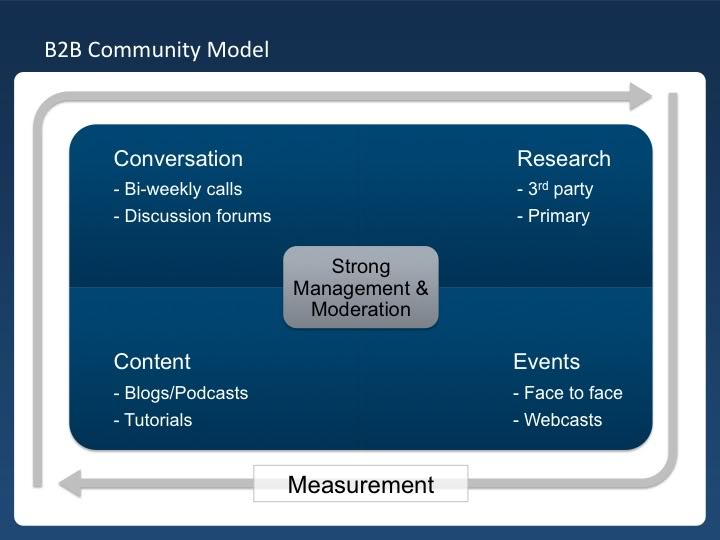
- B2B Community Model
I won’t lie to you; everything I mentioned above takes effort. But it’s worth trying, especially when it’s done right, because it will yield results. One thing that I failed to mention is the importance of integrating the recommendations above with your existing marketing/channel activity. Social media doesn’t live in a vacuum, and if nobody can find the fruit of your efforts, you may as well not have exerted the time and resources.
Am I missing anything? You bet I am. But that’s where you come in. What types of social media have you tried? What’s worked? Please feel free to share in the comments section below.


Social Media for B2B: It CAN be done | Return On Now…
Thank you for submitting this cool story – Trackback from PimpThisBlog.com…
Social comments and analytics for this post…
This post was mentioned on Reddit by [deleted]: [deleted]…
Aaron (and Tommy), thanks for the mention!
Aaron – your closing point about measurement is one that I’m happy to see broken down so clearly. I personally feel that measurement sometimes is spoken about as a very complicated issue, when in reality your explanation provides a great high-level framework in about a paragraph.
Katie Morse
Community Manager – Radian6
@misskatiemo
www.radian6.com
Tommy – thank you again for the opportunity to guest post on the Return on Now blog. And as a point of clarification, I think the stuff you/Anue are doing in the social media space is top notch. The only reason I didn’t mention Anue in the post is that I didn’t want it to come off as looking self-serving.
By the way, if there are any B2B social media folks reading this post, I’d love to hear what they are doing beyond the basic blocking and tackling I mentioned above to make social work for their companies.
Thanks again.
Best,
Aaron | @aaronstrout
As usual, this is great advice Aaron. I’d like to highlight one specific idea from your post… “talk about things that people in your industry care about.” This is critical and often missed by overzealous companies scrambling to get their message out in social media.
When RacheI and I started The Community Roundtable we sought to create a resource for community managers. While we share what we’re thinking about occasionally via Twitter/Facebook/our blog, we also share what others in the industry (including competitors) are saying around the topic of community management. It lends credibility and shows you’re not just saying “hey, look at me!” We found this approach really works to establish your brand in social media and has helped to put us “on the map” very quickly.
Also, I’d also suggest you take a look at what Dawn Lacallade is doing with community at SolarWinds for another great b2b example. They recently announced they’d integrated community into their product… a big step for community at b2b companies.
Thanks again for the thoughtful post.
Jim | @jimstorer
Jim – great imput as always. And regarding Dawn, how could I forget what Dawn is doing at SolarWinds (for those not in the know, Dawn Lacallade was the big brain powering Dell’s Ideastorm — she now manages SolarWinds B2B community)? Yet another great B2B resource (and now a public company) to put on my roster.
Best,
Aaron
Do you plan to keep this site updated? I sure hope so… its great!
[...] this link: Social Media for B2B: It CAN be done | Return On Now Share and [...]
Thanks to everyone for the insightful comments.
Katie – Metrics is probably the biggest “black hole” in most marketing teams’ social media strategy. That’s why most of them simply see it as a PR / SEO play. I’m very glad to see services like yours to help handhold the newbies and those who simply can’t change their perspective on marketing without the help.
Aaron – The pleasure is all mine. Thanks for the kind words about Anue Systems. It is a great example of how challenging it can be to make waves with a B2B audience who is hard to find and opposed to marketing of any sort.
Jim – Thanks for the input and the commentary about SolarWinds. I haven’t been exposed to Dawn’s work over there, so I need to go give a look. I’m a big fan of what you and Rachel are doing. There are precious few of us who really understand what “community” means and how it can benefit a business. I agree whole-heartedly that you MUST share other thought leaders’ opinions. If this is truly a conversation, it’s time to back off the “push” strategy and start contributing to knowledge expansion. That’s the hardest part for execs, particularly at larger companies – letting go of “control” (like they really had it in the first place) and becoming part of the solution.
Cheers,
Tommy | @tommy_landry
I echo the comment about Dawn Lacallade, and SolarWinds. I’m not sure how you could write that there’s not a public B2B community/social media example out there, when SolarWinds has pioneered the concept of B2B community for the past 4 years, right here in Austin (www.thwack.com). Not to mention what Spiceworks has done, also here in Austin.
I agree it’s frustrating that there are not enough B2B-centric cases out there. Here’s one that our company Velocity was involved in for a firm called ShipServ (www.shipserv.com). ShipServ is a maritime e-marketplace, helping the buyers and sellers of ship supplies around the world to reduce the costs associated with doing business together. More than $1 billion-worth of trading goes through TradeNet, the company’s electronic
trading platform.
Working with John Watton, ShipServ’s CMO, the goals of the campaign were to:
• Build awareness for ShipServ throughout the global shipping industry (without spending a fortune)
• Help build an online community of maritime purchasing professionals
• Start a dialogue with the community – extend and deepen the conversation
• Nurture prospects through drip-feed of content and ongoing dialogue
• Drive traffic to the website and downloads of new content.
The online campaign focused on generating a stream of content and micro-content, promoted and distributed through social media.
Designed to attract purchasing professionals in shipping companies and suppliers to the shipping industry – the campaign cost less than $30,000 and delivered a visible pipeline of more than $150,000 in new sales – an ROI of more than 5x.
If you want to find out more, here’s a link to a few more details.
http://www.velocitypartners.co.uk/2009/05/14/velocityshipserv-shortlisted-for-best-b2b-campaign-at-new-media-age-awards/
[...] may rival this approach? Some of the established players do have similar models (as indicated in Aaron Strout’s guest post from last week), but who do you think is best poised to get this right? And most importantly, what [...]
[...] was originally posted on my friend Tommy Landry's blog, Return on Now, as a guest post on February 8, 2010. Why is it that when it comes to conversation about [...]
Aaron,
Thanks for a well thought out post. My company MIKAMAI has a couple of B2B cases. Perhaps the most interesting was a private network for travel professionals. Travel professionals specializing in Italy needed a way to stay in touch between annual conferences so we created the Travel Trade Italia social networking platform.
Rich user profiles enable each member to specify market segment and geographic area which makes searching for other travel professionals as easy as a button click. Something that would be difficult to do on Facebook or LinkedIn.
The site was launched about 9 months ago and we now have almost 3000 travel professionals in the network. You can check out the network at the link below.
http://bit.ly/9oUPuT
I hope others can use this case to show that B2B social media not only works in theory but innovative companies are already creating their own communities. And if you are a travel professional or interested in the travel industry, feel free to join the network.
i have tried social media marketing for getting our new products to be known on the market. it seems to work well specially if the audience is targeted .-
[...] Social Media for B2B: It CAN be done | Return On Now [...]
[...] Social Media for B2B: It CAN be done | Return On Now [...]
[...] Social Media for B2B: It CAN be done | Return On Now [...]
[...] Social Media for B2B: It CAN be done | Return On Now [...]
I was very pleased to find this site.I wanted to thank you for this great read!! I definitely enjoying every little bit of it and I have you bookmarked to check out new stuff you post.
I really like the style of your writing. I found your blog on bing and decided to check out
[...] you are surely aware by now, I’m a huge fan of social media, new media, social networking, sharing/bookmarking, and pretty much every other cool social [...]