Mass AI layoffs may improve margins in the short term, but a replacement-first AI strategy can create long-term business risk when companies overlook the demand, institutional knowledge, customer trust, and decision quality that revenue depends on.
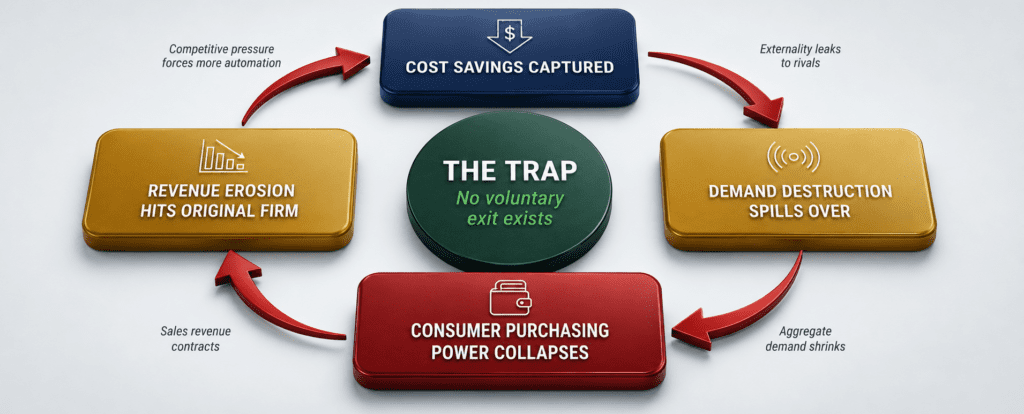
A March 2026 paper by Brett Hemenway Falk and Gerry Tsoukalas, titled The AI Layoff Trap, gives executives a useful economic model for this problem. The paper argues that rational firms can keep automating beyond the point that helps the broader market, because while each firm can capture its own cost savings, the demand loss will spread across competitors and the wider economy.
That creates a strategic problem, something much bigger than merely a workforce issue.
AI can improve productivity, but leaders need a governance model that helps them decide where:
- AI should assist
- People should stay involved
- Replacement could weaken the business system that supports future revenue
The Cost Savings Look Cleaner Than the Full Economic Picture
AI replacement can look attractive when decision makers review it through a narrow cost lens.
For example, let’s say a company reduces payroll, shows a leaner operating model, and tells a stronger margin story. That logic can make sense inside one company, especially when competitors use AI to reduce their own labor costs.
But the company-level view fails to capture the full economic loop.
Workers also act as customers. They buy software, housing, healthcare, financial services, entertainment, education, food, travel, and business services. Their income supports demand across many categories.
When one company replaces workers, that company captures the savings.
BUT, when many companies pursue the same strategy at the same time, the broader market will suddenly lose a lot of purchasing power.
No individual firm will carry that full loss, because the damage spreads across competitors, suppliers, partners, and adjacent industries.
That is the demand externality at the center of the AI Layoff Trap: The cost savings stay concentrated, while the demand loss spreads.
The result can look rational at the firm level, while creating weaker conditions for the market as a whole.
What the AI Layoff Trap Adds to the Discussion
Falk and Tsoukalas use a competitive, task-based model to explain why companies might continue automating, even when leadership understands the broader demand risk.
For executives, the uncomfortable point is that awareness doesn’t solve the problem. A leadership team can see the risk, know that displaced workers have less money to spend, and still choose automation, because the savings hit its own P&L faster than the market damage does.
Each company receives the full benefit of its own labor savings, while it absorbs only part of the demand loss that follows when displaced workers lose income.
That imbalance can push firms into an automation race, where every company protects its margins in the short term, and the market carries the damage over time.
A leadership team may recognize the broader economic risk, yet still keep replacing labor, because competitors may do the same.
In that environment, any company that does the right thing by slowing down may carry a higher cost structure, without gaining enough direct benefit from the demand it helps preserve.
The paper argues that this dynamic can leave both workers and firm owners worse off. It also argues that several common voluntary remedies fail to eliminate the core incentive. These remedies include wage adjustment, free entry, capital income taxes, worker equity participation, universal basic income, upskilling, and bargaining.
Executives should treat replacement-first AI as a strategic risk, not just an efficiency play.
The Market Signals Deserve Attention
This theory matters, because the market has already started moving in this direction.
Block cut more than 4,000 employees in February 2026, reducing its workforce by roughly 40%. Jack Dorsey tied the smaller operating model to AI-driven productivity gains.
Salesforce offers another high-profile example. Marc Benioff said the company reduced customer support headcount by 4,000, after AI agents began handling a large share of customer conversations.
The broader tech labor market also shows continued pressure. Crunchbase reported that around 127,000 workers at U.S.-based tech companies lost jobs in 2025. Its 2026 tracker continues to show AI investment, restructuring, and efficiency efforts as recurring themes behind workforce reductions.
Every layoff has its own context. Some companies overhired, while others needed to protect margins. Some changed their operating models, and many of them cite AI because it gives a cleaner explanation for decisions they already planned to make.
Even with that caveat, executives should pay attention to the pattern.
AI gives companies a faster way to reduce labor cost at scale. That capability can create real value, but it also raises the cost of weak strategy.
Replacement Is NOT the Same as AI Strategy
A replacement-first mindset makes AI adoption look simpler than it is.
The company identifies work that AI can handle, removes people from the process, and counts the savings as the business case.
That may work for some narrow tasks with low judgment requirements. However, it becomes a much bigger risk, when the same logic reaches workflows that depend on context, customer nuance, institutional knowledge, exception handling, or cross-functional decisions.
Executives need a better distinction between automation and strategy.
| AI Approach | Primary Focus | Strategic Risk |
|---|---|---|
| Replacement-first automation | Labor cost reduction | Demand loss, weaker review layers, knowledge loss, lower service quality |
| Productivity augmentation | More output from existing teams | Role confusion, inconsistent workflow ownership, uneven quality control |
| Governed Human + AI workflows | Faster work with defined oversight | Requires clear decision rights, approval paths, and accountability |
| Strategic AI adoption | Long-term operating strength | Requires leaders to measure more than cost savings |
AI can improve work, without turning every productivity gain into a layoff.
That distinction matters, because a company can cut too deep and still look efficient for a while. The damage will show up later through weaker execution, slower learning, thinner customer support, lower trust, or reduced overall market demand.
The Executive Question Needs to Change
Many AI conversations still start with the same question: “How much labor can this remove?”
That question has a place, but it shouldn’t lead the strategy. A better executive question is focused on where AI can improve the work, while protecting the business system that creates revenue.
That question brings cost, demand, decision quality, institutional knowledge, customer experience, and workforce design into the same discussion.
AI governance belongs inside that operating model. It shouldn’t sit in a compliance silo or a generic policy document no one uses, and it also shouldn’t act like slamming on the brakes after teams have already moved ahead.
The right governance model helps leaders make better workflow decisions before automation spreads across the business.
What Leaders Need to Govern
Most AI adoption plans focus on tools, use cases, and productivity gains. Those pieces matter, but they don’t create a complete operating model on their own.
Decision makers also need to define how Human + AI work should function across real business workflows.
| Governance Question | Why It Matters |
|---|---|
| What role should AI play in this workflow | Prevents teams from treating every AI use case as full automation |
| What should people still own | Keeps accountability tied to human judgment |
| Which outputs need review before action | Reduces the risk of confident but flawed execution |
| Which decisions require approval | Protects revenue, legal, customer, and brand-impacting choices |
| What happens when AI produces weak output | Keeps exception handling inside the workflow |
| Which productivity gains should create capacity instead of layoffs | Helps leaders balance efficiency with long-term resilience |
Many companies need more structure here. You can’t just define an operating model around tools, pilots, and pressure to move fast.
A company can test AI across departments and still have no shared logic for where AI should assist, where people should lead, which outputs need review, and who owns the final decision.
That gap creates risk, because AI adoption will start to spread through local decisions, before leadership defines the rules for judgment, review, and accountability.
Where HAIF Fits
I built HAIF, the Human + AI Framework, to help companies address that gap.
HAIF gives leaders a practical way to decide where AI should assist, when people should lead, and how workflows should operate when both contribute to the outcome.
The framework doesn’t argue against automation, but it does push back against knee-jerk labor replacement.
That distinction matters. Many companies do need AI to improve productivity. They need faster research, cleaner reporting, stronger analysis, better drafting support, tighter processes, and more consistent execution.
But you can’t build a stronger company just because you figured out how to push things through faster.
A stronger operating model will define the role of AI and the role of people, before automation spreads through the business.
AI can assist, summarize, recommend, draft, monitor, and accelerate. People still need to define the objective, interpret context, approve decisions, manage exceptions, and own the result.
That structure protects the company from one of the most common risks in AI adoption: work moves faster, but accountability gets weaker.
Augmentation Creates a Stronger Long-Term Strategy
A well-governed augmentation strategy will give leadership more options for how to use productivity gains.
Some gains should reduce waste or shorten cycle times, while others should improve quality, increase capacity, or create a better customer experience.
In other cases, AI should free more senior employees from low-value work, so they can spend more time on higher-value decisions.
A replacement-first strategy narrows those options too quickly. A governed augmentation strategy gives executives a better way to capture AI-driven efficiency, without weakening the company’s ability to learn, adapt, and serve customers.
AI Strategy Needs a Wider Time Horizon
Those outcomes may all help the business, but leaders still need to examine what happens after the first-order benefit:
- Does the company retain enough knowledge to adapt?
- Do customers still trust the experience?
- Do teams still catch errors before they reach the market?
- Does the company protect revenue quality, not just margin?
- Does the broader customer base remain strong enough to support future growth?
Once leaders are aware of the AI Layoff Trap, they’ll have to think across two levels at once: the firm-level incentive and the market-level consequence.
That is where macroeconomics and executive strategy meet. A company can make a decision that looks rational in isolation, while still contributing to a weaker market that hurts future revenue.
The Better Path: Governed Human + AI Work
The better path doesn’t require companies to slow AI adoption. They just need a stronger operating model.
Leaders need to define which workflows AI can improve, which decisions still require human judgment, and which forms of automation carry too much long-term risk.
And that work needs to happen before replacement becomes the default answer.
A governed Human + AI model gives companies a more durable way to pursue efficiency. It helps teams move faster while keeping the people, context, and judgment that keep the business healthy.
AI should make the company stronger, not just smaller. Or faster.
That means leaders need to measure more than cost reduction. The price is too large if they overlook things like quality, trust, decision control, revenue durability, and the company’s ability to keep learning as the market changes.
Need Help Building a Human + AI Governance Model?
AI can help your company move faster, but speed without governance creates its own risks.
If your leadership team needs a practical way to decide where AI fits, where people stay involved, and what deserves review before action, my AI Workflow Governance Consulting service can help. Reach out to me today and let’s talk about your situation in real time.


Tommy Landry
Latest posts by Tommy Landry (see all)
- Do Press Releases Help AEO and GEO? The Real Value of AI Corroboration - September 14, 2026
- The HAIF Continuum: How Internal Data Becomes AI Representation - September 10, 2026
- The AI Marketing Signal Brief: AI Trust Now Depends on Control Points - August 28, 2026