
When an AI platform describes your company incorrectly, your first instinct will probably be to look at the answer itself.
You check which websites it cited, revise a page that contains outdated language, or try several prompts to see whether the response changes. Those steps can help you diagnose the problem, but the wrong answer often began much earlier.
Your internal data defines the business, and then your go-to-market narrative explains that business to your sales and marketing teams. They weave it into your public content, which presents the story to the market. Other websites add their own commentary.
Then, AI systems retrieve, compare, and interpret what they can find across those sources.
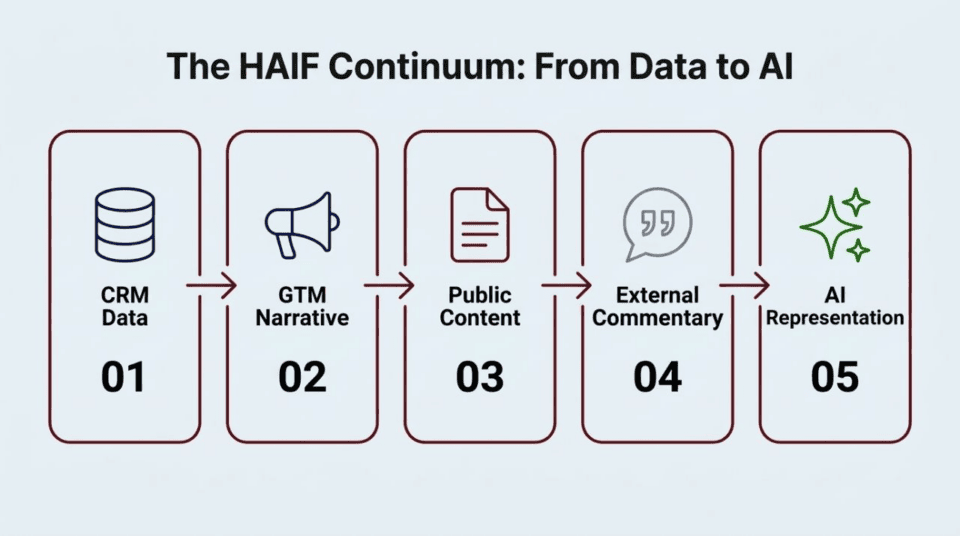
The HAIF continuum connects those five stages:
- CRM data
- GTM narrative
- Public content
- External commentary
- AI representation
Each link carries information from one stage to the next. When the information remains consistent, buyers and AI platforms will have a better chance of understanding your company correctly. But if the stages are in any way misaligned, the final AI answer is sure to reflect that confusion.
AI errors begin inside your company
Most people treat an inaccurate ChatGPT, Perplexity, or Google AI answer as an external visibility problem. They’ll check the website, review rankings and citations, and maybe rewrite a service page or publish another blog post on the topic.
That response is focused on only the end of the continuum.
Your public content can only communicate the positioning that your company has already agreed to. If your CRM, sales materials, executive messaging, and website describe different businesses, another content edit won’t reconcile them.
Imagine that your CRM divides customers into two distinct groups. Your current sales deck focuses on only one group, while your website is still using language from an earlier offer. Third-party profiles will almost surely repeat a mix of both versions.
An AI platform has no reliable way to know which version represents your current strategy. Depending on the system and query, it could rely on the clearest source, the most recent source, the source it considers most trustworthy, or a combination of all of the above. And to make matters worse, different platforms will reach different conclusions…from the same conflicting information.
You need to find where the message first split, before you can correct what is showing up at the end.
Stage 1: Your CRM data sets the base facts
Your CRM should contain the basic facts that support your positioning. It tells you who buys from you, which problems they need to solve, which products or services they are buying, how long it takes to close a sale on average, and which customers buy again.
Those records don’t write your market narrative for you, but they should keep that narrative grounded in the business you actually operate.
Problems begin when your CRM contains incomplete, inconsistent, or outdated information. Salespeople classify similar accounts differently, other teams use interchangeable names for the same service, and old customer segments remain active long after your strategy has changed.
When leadership relies on those records, the inconsistency will move into both planning and messaging.
Start with a few practical questions:
- Do your customer records match the audiences you say you serve?
- Does your CRM use the same names for products and services that your sales and marketing teams use?
- Can you separate your best-fit customers from accounts that simply happened to close?
- Do revenue, retention, and sales-cycle data support the priorities in your current plan?
- Has anyone reviewed the definitions behind your fields and reports this year?
You don’t need perfect data before you make a marketing decision; you just need enough agreement to know which facts your narrative should reflect.
The go-to-market narrative explains who you help, what you offer, which problems you solve, and why buyers should choose you. Your executives, marketers, and salespeople should recognize that it is the same company when they hear it.
That doesn’t mean everyone needs to recite identical language, but the basics and the priorites shouldn’t change between one team to another.
Your narrative will weaken when sales targets one audience, marketing writes for another, and executives describe the company through a third lens. Each version can sound reasonable on its own, while the combined message becomes confusing.
Look for differences in:
- Ideal customer profiles
- Product and service names
- Primary problems you solve
- Industries and company sizes you prioritize
- Competitive differences
- Proof points and performance claims
- The language different groups use to describe business outcomes
Your GTM narrative should reconcile those choices, before your marketing team turns them into campaigns, sales materials, and website copy.
Stage 3: Public content makes the narrative visible
Your website, blog post, case studies, press releases, executive profiles, webinars, and social posts give buyers and AI crawlers things they can read.
This stage often reveals disagreements that remained hidden inside the company. Your homepage promotes one category while your service pages use another. An executive bio still describes an old market focus. A case study uses product names that no longer appear anywhere else.
AI systems don’t automatically know which page you consider authoritative. They encounter a collection of public documents created at different times for different purposes.
You can reduce that ambiguity when your most important content consistently answers basic questions:
- What does your company do now?
- Who do you serve?
- What do you call each offer?
- Which problems does each offer solve?
- What evidence supports your claims?
- Which people and organizations connect to your company?
You don’t need to repeat the same paragraph across every page. Just be sure that your content reinforces the same core facts, while giving each audience the detail it needs.
Stage 4: Other websites add commentary you don’t control
Your company isn’t the only source that describes your business. Review websites, industry publications, directories, partners, customers, associations, news coverage, podcasts, and social communities all contribute information.
Some sources will copy language directly from your website. Others will interpret it, shorten it, compare it with competitors, or combine it with older information.
This creates a feedback loop. An outdated public profile can influence a journalist, whose article then becomes a source for another website or AI answer. Or maybe a customer will use an old product name in a review, because your own materials never made the change clear.
You can’t control every outside description, and you shouldn’t try. Focus on making accurate information easier to confirm.
Review the sources that are most likely to influence buyers in your market:
- Major company and industry directories
- Partner and association profiles
- Review platforms
- Executive biographies
- High-authority articles and interviews
- Product comparison pages
- Frequently cited community discussions
Correct factual errors when the publisher provides a reasonable path to do so. More importantly, make sure your own public information provides outside writers and platforms with a dependable reference.
Stage 5: AI representation reflects the available evidence
AI representation includes more than a citation. It covers how an AI platform categorizes your company, summarizes your services, compares you with competitors, describes your reputation, and decides whether to mention you at all.
Retrieval-based tools can cite current webpages in an answer. Generative models also rely on broader associations learned from public information. Each system handles sources, freshness, and uncertainty differently.
Consistent information won’t guarantee a perfect answer. AI platforms can still misread sources, favor outdated material, make unsupported inferences, or generate false details.
Here’s the key point: A consistent public record gives them less conflicting material to interpret. You can’t expect the AI platforms to sort it out for you.
This distinction also explains why an AI citation audit can’t always identify the full problem. Sometimes, the cited webpage accurately repeats a message that was already wrong when your company created it. If you simply fix that page without checking the underlying strategy, you’ll overlook that the same problem exists across your website or third party mentions.
Find the first break in your HAIF continuum
When you discover an inaccurate AI answer, save the output and document the prompt, platform, date, and citations. Then work backward through the continuum, analyzing the following five areas:
- AI representation: What exactly did the platform get wrong, omit, or overemphasize?
- External commentary: Which outside sources support that version?
- Public content: Where does your own content confirm or contradict it?
- GTM narrative: Which version do your sales, marketing, and leadership teams currently use?
- CRM data: Do your internal records support that narrative?
The first clear disagreement you find will tell you where to focus.
And the reverse order is very important for this analysis, because it will prevent you from modifying the final link in the chain, while the earlier links keep feeding it conflicting information. You’ll end up with the same exact problem in another place along the way.
Give someone responsibility for the whole chain
Most companies divide this continuum among several teams, like RevOps owning CRM decisions, Sales and Product Marketing owning GTM, and Communications handling customer facing content. And then, someone else (usually an SEO specialist or web analyst) is left to monitor and report on AI answers.
Each team can perform its own work well while gaps remain between them.
Rather than designating one person to execute every task, focus on establishing clear ownership for the connections between stages. Someone should verify that CRM definitions support the current market strategy, public content reflects that strategy, and AI monitoring feeds useful findings back into the business.
You can catch many of these problems before they spread throughout the business with a simple quarterly review. Compare the language and facts across your CRM, sales materials, priority webpages, major outside profiles, and a set of repeatable AI prompts. Record disagreements, assign owners, and verify the corrections during the next review.
Check the continuum before you fix the citation
An inaccurate AI answer can provide you with useful evidence, but the answer itself won’t always tell you where the problem began.
Follow the information backward: Check the outside sources, your public content, the GTM narrative, and the CRM data underneath it. Once those links align on the basic facts, your SEO, AEO, and GEO work will have a stronger foundation upon which to build your external visibility.
The final question isn’t limited to what an AI platform said about you today. You need to know which link in your HAIF continuum your company hasn’t checked this year.


Tommy Landry
Latest posts by Tommy Landry (see all)
- Do Press Releases Help AEO and GEO? The Real Value of AI Corroboration - September 14, 2026
- The HAIF Continuum: How Internal Data Becomes AI Representation - September 10, 2026
- The AI Marketing Signal Brief: AI Trust Now Depends on Control Points - August 28, 2026