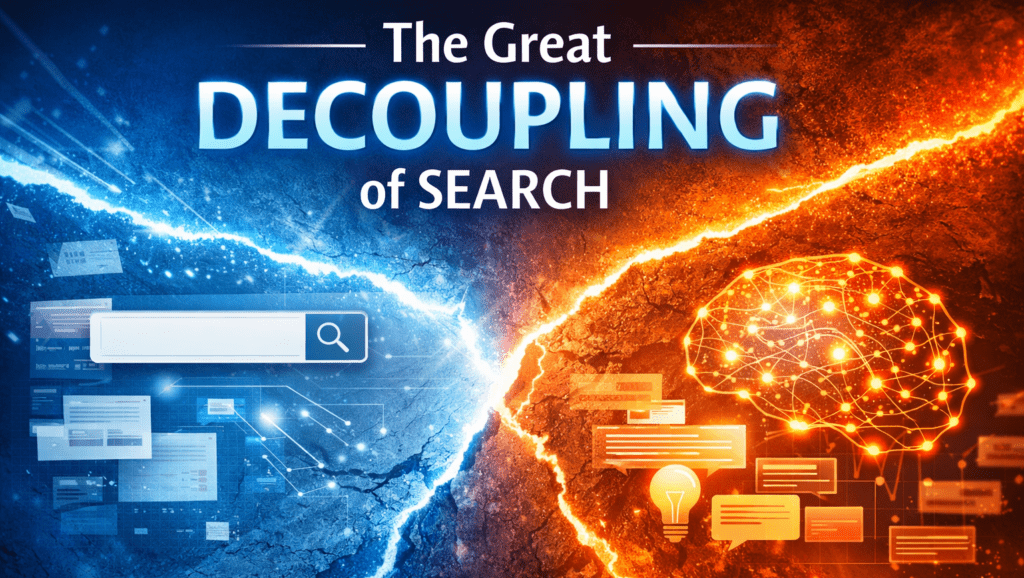
Search didn’t disappear. It fractured.
By the end of 2026, I am predicting that AI will drive more than 30% of daily search and discovery activity, but the number itself matters less than the structural shift underneath it.
Search intent no longer flows through a single channel or a single system. It now splits into two very different paths, and each one rewards a different type of marketing work.
Most teams still lump everything under the same mental model of SEO. That model no longer holds up.
People have started to ask AI to find things, and they’re also asking it to think.
Those actions may look similar from the outside, but they rely on entirely different mechanisms. And equally important, they create very different visibility outcomes for brands.
This is the decoupling most marketers still miss.
Two Types of Search Now Run in Parallel
When a user asks an AI system a question, one of two things happens.
In some cases, the system searches the live web, pulls fresh information, and cites sources in real time.
In other cases, the system never touches the web at all and answers purely from what it already knows.
Both behaviors count as search. They just operate on different layers.
The first path drives what I call Answer Engine Optimization. The second path drives Generative Engine Optimization.
We cannot treat them as interchangeable, like much of the industry is doing. This will lead to blind spots that compound over time.
AEO Replaces the Live Web Experience
Answer Engine Optimization targets systems that retrieve current information. These systems use retrieval augmented generation, which means they actively pull content from the web when they respond.
You see this behavior in platforms like ChatGPT Search, Perplexity, and Google AI Overviews. Users rely on these tools for news, shopping research, comparisons, pricing, and anything that changes frequently.
Right now, these systems process an estimated 3.2 billion queries per day, and they already satisfy roughly 22% of daily informational intent.
That share will keep climbing as users treat AI more as a live research assistant and less like a static reference tool.
This is where traditional search volume migrates first.
To compete in this environment, freshness still matters, authority remains important, and content structure suddenly carries significantly more weight.
AI systems need to retrieve, parse, and cite your content without guessing, and that requires clarity at the entity, page, and domain level.
If your content exists but machines can’t reliably interpret it, you won’t win citations.
And without citations, you will fail to show up in the answer.
GEO Shapes the Model’s Default Thinking
Generative Engine Optimization operates on a completely different plane.
Here, the model does not browse, nor does it fetch links.
It answers based on its internal weights, which reflect what it absorbed during training and fine tuning.
These queries look like strategy questions, explanations, recommendations, and ideation prompts.
Users ask things like how to approach a problem, what works best in a given scenario, or which brands they should trust.
This market already processes an estimated 1.8 billion queries-per-day, and it continues to grow as people move more of their thinking work into AI systems.
You can’t optimize for GEO by chasing rankings or clicks. You’ll need to influence how models talk about you when they have been trained, and aren’t just retrieving that information at the time of the query.
By 2026, GEO driven mentions are expected to account for roughly 12% of brand discovery, even though they rarely show up in analytics dashboards.
If your brand is absent from the model’s training data, it won’t appear in default conversations unless the user explicitly forces a web search.
That gap creates a quiet but powerful visibility divide.
How We Reach the 30% Threshold
The 30% share forecast doesn’t come from a single system overtaking Google overnight. It comes from two different forms of AI search growing in parallel.
AEO will continue to usurp traditional informational search, and it will push toward roughly 20-to-22 percent daily share by the end of 2026.
GEO will contribute another 8-to-10 percent through conversational synthesis, planning, and brand evaluation.
Together, they are poised to redefine what search looks like in practice.
Someone might ask AI to find flight options using live data, then ask it to plan an itinerary without browsing.
Both actions satisfy search intent, and neither one requires a blue link.
That pattern already plays out many millions of times every single day.
Google Now Plays Both Sides
Google feels this shift more than any other company.
Google AI Overviews compete directly in the AEO market by pulling live links and preserving the familiar search experience.
Meanwhile, Gemini native competes in the GEO market by answering from memory and minimizing retrieval.
Google built two systems because it has to fight two battles at once.
That internal tension explains much of the volatility marketers see today.
Traffic is dropping while mentions are increasing, attribution is blurring, and traditional reporting is struggling to keep up with how discovery actually works.
This isn’t noise. It’s structural change.
Why Human Content Became the Premium
AI can produce answers at massive scale, so the answers themselves will stop being the differentiator.
As AI handles more summaries and fundamentals by default, neither one will carry much weight as a signal of expertise.
Human produced content now signals something else entirely.
It shows judgment, experience, taste, and point of view. AI can remix information endlessly, but it simply cannot replace firsthand experiences.
That shift turns the old content playbook on its head. In this scenario, volume no longer creates advantage, and you won’t earn trust just because the output is high quality.
The premium comes from presence, not production.
What This Means for Marketers Right Now
You now need two strategies, even if you don’t label them that way internally.
AEO demands operational excellence. Your content needs clean entities, clear structure, and signals that machines can retrieve and cite with confidence.
GEO demands long term positioning. Your brand needs consistent presence across trusted sources, communities, and narratives that models will absorb and repeat over time.
You can’t shortcut either path, and you can’t fake credibility in a system designed to synthesize consensus.
If you want to show up at all in early funnel searches and queries, this is the way to do it. Otherwise, AI will simply synthesize sources and provide the answer for you.
Human + AI systems reward clarity and punish noise. Or as people in the industry have started to refer to the noise: AI slop.
The Shift Most Teams Still Underestimate
This change doesn’t remove marketers from the equation, however, it does raise the bar.
AI can handle distribution at scale, but humans still need to decide direction, context, and what deserves attention in the first place.
AI can answer questions, and humans should define the narratives those answers draw from.
The brands that win in 2026 won’t chase output. They’ll decide where automation belongs and where human judgment still matters, then build around that line deliberately.
Search didn’t vanish. It split, and marketers who understand both halves will shape how discovery works next.


Tommy Landry
Latest posts by Tommy Landry (see all)
- The Missing Link Between RevOps and AI Discoverability - March 12, 2026
- Black Hat AEO Is Here: Google AI Overview Manipulation Is Happening - February 24, 2026
- Where AI Introduces Risk Into Revenue Planning - February 19, 2026