Make Sure AI Strengthens Your Revenue Decisions Instead of Undermining Them

AI already influences how you interpret performance.
You may use it to summarize dashboards before leadership meetings, compare performance across time periods, evaluate channel contribution, rank opportunities, or model forecasts for the next quarter. Those outputs don’t stay inside a tool. They shape hiring decisions, territory design, budget allocation, and the expectations you set with your board.
If the systems feeding those tools don’t use consistent definitions or rely on disconnected data sources, AI will carry those inconsistencies forward into your planning process.
I work directly with you and your leadership team to examine how your organization is using AI, where it influences revenue decisions, and what needs to be tightened so the structure holds up as you grow.
When done properly, this work will help you:
- Have more straightforward forecasting conversations based on shared assumptions
- Avoid debates about which number is the source of truth in attribution discussions
- Reduce the need for late-quarter revisions
When your team validates the data inputs early in the process, you can prevent late-quarter surprises and reduce the need to revise targets under pressure.

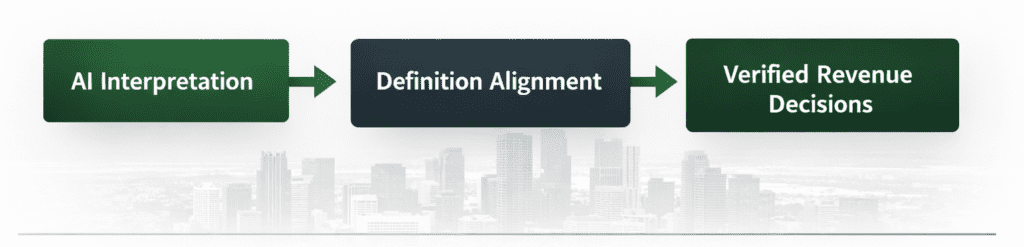
AI-generated insight should pass through defined structure before it influences revenue outcomes.
How Structural Gaps Show Up in Real Companies
As your company grows, the way you define and measure performance will change. You may introduce new products, expand into new markets, adjust pricing models, refine sales compensation plans, or modify how you recognize revenue for reporting purposes.
As those changes roll through the business, marketing may reorganize segments, sales may revise pipeline stages, and finance may adjust reporting logic to reflect new realities.
AI can’t determine which definitions are outdated and which are current. It uses whatever structure exists at the time it runs. This can introduce risk into your revenue planning.
If marketing and finance calculate revenue differently, AI will incorporate that difference into the summaries you rely on. When you change the attribution logic without updating reporting to match, your performance comparisons are likely to become unreliable. And if marketing and sales modify your segmentation without reconciling historical data, you’ll end up with forecasts that blend numbers calculated under different frameworks.
You won’t always see the root cause immediately. But there will be signs, like having to revise a forecast in the last two weeks of a quarter, budget decisions that fail to provide the expected results, and executive or board meetings where two leaders present conflicting information, both of which are “technically” accurate depending on how they are calculated.
These situations are rarely the result of a broken tool. They happen because no one defined how AI should participate in your revenue system before it began influencing decisions.
What We Do Together
This engagement is hands-on. I don’t deliver a framework and step away. We will collaborate to work through the systems directly.
Map Where AI Influences Decisions
We will walk through your reporting and forecasting workflows and identify exactly where AI-generated interpretation enters the process. That includes dashboard summaries, attribution analysis, forecast modeling, and pipeline evaluation.
By the end of this step, you will clearly understand how AI participates in your revenue decisions today.
Reconcile Definitions Across Systems
If your CRM, marketing dashboards, and financial reports use different definitions for revenue, pipeline, or contribution, AI will scale those differences into your planning process.
We will review how your teams define revenue, how each system calculates time periods, how each applies segmentation, and how the attribution logic works.
Where definitions conflict, we will move to resolve them so the AI operates from the same playbook your leadership team relies on.
Build Verification Into Your Operating Rhythm
Using AI, you can generate answers very quickly. However, a member of your team needs to verify these outputs before you make decisions or take action on them.
Together, we will determine where in the process you need reviews before AI-generated interpretation starts to impact revenue targets, budget allocation, territory planning, or revisions to your forecasts.
Those verification points will be built into how you already operate, so they support execution, rather than slowing it down.
Clarify Ownership
As you further embed AI into your reporting and planning workflows, it is important to explicitly spell out these responsibilities.
We will identify who should review AI-driven summaries, how they will validate the interpretation, and when to shift to cross-functional discussion for deeper analysis or evaluation.
We will then decide who owns the review and where it happens, so no AI-generated output moves forward without someone checking it first.
Paid Media Budget Allocation Strategy
Paid media often moves faster than the rest of your revenue system. When AI-generated summaries influence how you interpret channel performance, those interpretations can quickly turn into budget shifts.
We won’t step in to manage campaigns or adjust bids. Instead, we will examine how your team interprets paid performance within your planning process. We will review attribution logic, revenue definitions, and how budget decisions connect to your forecast.
When your team aligns attribution logic and revenue definitions, paid acquisition will strengthen your revenue plan instead of introducing conflicting signals.
Who This Is For
I work with founders, CROs, CMOs, and Revenue Operations leaders who are accountable for delivering predictable revenue performance.
AI already affects your planning and reporting. This engagement makes sure you decide how it participates before it influences major revenue decisions.
How This Connects to Visibility
Revenue performance is not only shaped internally. AI also influences how buyers discover and evaluate your company.
Because my background in AI-Driven Discovery includes SEO, Answer Engine Optimization, and Generative Engine Optimization, we can ensure that the way you define performance internally matches how these systems represent your company externally. When those two sides reinforce each other, you can forecast your revenue trajectory with far fewer surprises.
What to Expect
We begin with a working session where we review how you currently use AI in your reporting and forecasting workflows. From there, we will examine definitions, attribution logic, data flow, and decision points in detail. After we’ve worked through those details, we can make structural adjustments together, define verification steps, and clarify ownership so the system remains reliable as you further expand the automation capabilities.
This is collaborative work focused on strengthening the structure behind your revenue decisions.
Let’s talk about how AI currently influences your revenue planning and what tightening the structure would look like.