An executive team commissions a Generative Engine Optimization program. They review the deliverables, where they see rewritten website pages, a batch of Q&A content, FAQ sectoions added, and some new structured data. The agency calls the project complete.
Six months later, the company still doesn’t appear in relevant AI-generated answers. And why is that? Well, nobody outside the building reinforced anything they were claiming on the website.
The “GEO” program failed before it started, because it wasn’t GEO. It was on-page optimization with a trendy new label.
Your Website Speaks First; It Shouldn’t Speak Alone
You company website remains one of your most important assets, because it establishes the official record. It defines preferred descriptions, service language, leadership information, and the relationships between your offerings and the problems you solve. Without that foundation, external sources have nothing consistent to reference.
But here’s where most GEO proposals fall apart.
Generative models don’t learn exclusively from your domain. They form associations across thousands of sources during training and ongoing updates.
When those external sources contradict your claims, ignore your existence, or describe you inconsistently, the model will form a weaker or inaccurate picture. Your own pages can’t fix that alone.
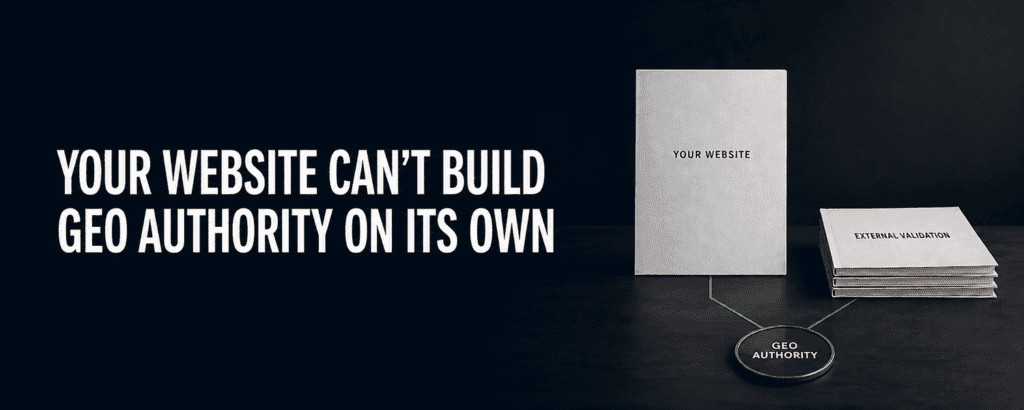
A single source (no matter how authoritative) will always carry limited weight, unless you build out third party signals that match what it says.
Entity Associations Require Outside Evidence
Generative models organize information around entities, such as people, companies, products, locations, and categories.
For them to properly associate your brand with a specific capability, you need credible third-party sources verifying that it’s the right match.
If your website says you specialize in enterprise compliance software, but no industry publication, analyst report, partner directory, or credible media outlet mentions that expertise, you won’t succeed at GEO in spite of your world class web content. You can’t simply make claims loudly and expect generative engines to believe it…without external evidence.
That’s the gap between managing an information source and third party validation.
External validation works as a multiplier. Each consistent mention from a recognized authority will help reinforce the signals your own content sends.
If you appear in relevant industry roundups, earn citations from respected publications, and maintain accurate entity data across trusted directories, you’ll build a stronger digital footprint.
Credible third-party mentions aren’t just nice to have. They’re fundamental to how generative models evaluate notability and trust.
A practical distinction: AEO (Answer Engine Optimization) primarily addresses retrieval-based experiences, where platforms pull information from websites and cite sources. GEO is more about learned entity associations formed during model training and subsequent updates. Both benefit from external evidence, but GEO especially requires it.
Notability Isn’t Self-Declared
You can’t publish a press release declaring yourself notable, and expect generative models to agree. Notability accumulates through external recognition.
Stronger signals include things like media coverage, analyst mentions, award considerations, speaking engagements, association memberships, and consistent directory presence. It is NOT comprised of astroturfing reddit or Quora, so beware of any program that suggests automated comment spam as a GEO tactic.
I use an expanded trust model called N-E-E-A-T-T: Notability, Experience, Expertise, Authoritativeness, Trustworthiness, and Transparency. Notice that notability leads the framework. Without it, the other signals struggle to gain traction in model training data.
The practical takeaway is straightforward: Any GEO proposal that doesn’t include a plan for evaluating and strengthening third party validation of your positioning is simply optimizing your echo chamber.
What Genuine GEO Work Includes
Real Generative Engine Optimization addresses entity consistency, product and service language alignment, third-party mentions, notability building, and ongoing monitoring of how models represent your organization across prompts that don’t involve live retrieval.
It asks different questions:
- Which entities should be associated with the brand?
- Where do credible external sources already confirm those associations?
- Where are the gaps between how you describe yourself and how these others do?
- Who can publish or contribute independent coverage that strengthens the picture?
- How do model outputs change over time as more sources align and confirm your entities?
You can’t control how generative engines will answer these questions by rewriting landing pages.
I’m not saying to abandon content strategy altogether. What you write about and how you structure it are all absolutely still relevant, but those primarily support SEO and AEO.
Your content is important for strengthening your website as a retrievable, citable source. But this is more about making it easier for retrieval systems to extract and cite you.
While complementary to GEO, It doesn’t replace the need for third party validation.
A Counterargument Worth Addressing
Some practitioners argue that a technically sound, well-structured website with strong content should receive enough citations and external mentions naturally over time. They argue that the external signal problem will eventually work itself out.
That position works if you have unlimited patience and no competitors actively building their own footprint. Oftentimes, the fastest competitor will land the most important citations, spots roundups, and publication coverage. Being first will literally give you a head start on your competition.
Waiting and hoping is not a strategy, when the rest of the industry is working proactively to provide the third party signals the generative models need.
I’ve watched companies with excellent websites remain invisible in generative recommendations, because their external authority footprint never developed. Even with solid content and a clean technical foundation, they failed to build awareness more widely. And the models reflected that reality.
Evaluate the Proposal Honestly
When a consultant or agency presents a GEO program, look past the label. Count the deliverables that involve sources you don’t control. If every tactic lives on your own domain, you’re holding an on-page optimization proposal.
That work has value under the right name. But make sure it’s actual GEO and not content generation and on-page with a shiny new label slapped on it.
A credible Search and AI Visibility program will coordinate the SEO foundation with better structured content and external validation. When done properly, your website will serve as the authoritative starting point rather than the entire strategy, like old school SEO did.


Tommy Landry
Latest posts by Tommy Landry (see all)
- Your Website Can’t Build GEO Authority on Its Own - August 11, 2026
- Most GEO Advice Is Actually AEO. Here’s Why the Difference Matters. - August 6, 2026
- The AI Marketing Signal Brief: AI Trust Now Depends on Evidence You Can Control - August 4, 2026