Local visibility now depends on more than traditional Search Engine Optimization (SEO). Customers ask AI tools for recommendations, directions, and service comparisons.
Expecting short, clear answers, they want confidence without digging through long lists of links.
Your business needs strong local signals that every AI model can understand and trust.
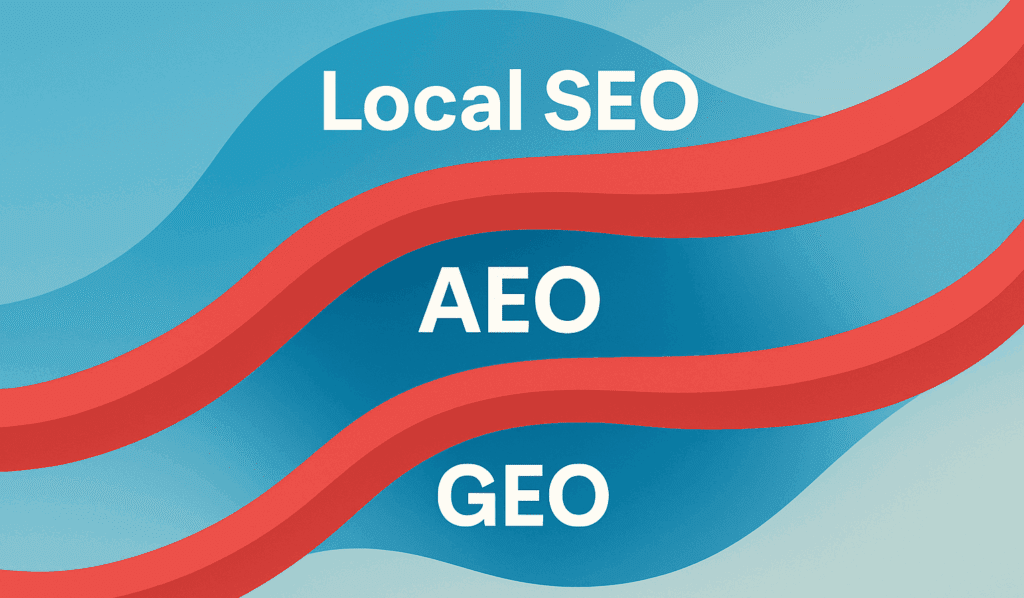
Local SEO, AEO (Answer Engine Optimization), and GEO (Generative Engine Optimization ) now work together. Each one supports a different layer of discovery.
- Local SEO strengthens organic visibility and maps positioning
- AEO strengthens your presence inside Google’s AI-driven results and voice search
- GEO strengthens your visibility inside LLMs such as ChatGPT and Perplexity
You need all three if you want full local coverage.
This guide explains how each layer works, how they differ, and how AI systems read the signals that influence your authority in your community.
Local SEO vs AEO vs GEO: How They Work Together
Local SEO focuses on proximity, relevance, and prominence.
You will still need to optimize your Google Business Profile, your citations, and your website.
AEO focuses on how Google interprets your entity when it generates AI Overviews and rich snippets, and how voice search agents parse and interpret your content.
Google looks for direct answers, structured data, and clear signals about your business categories and services.
GEO focuses on how generative engines interpret your entity and your content.
ChatGPT, Perplexity, Claude, and other models read and summarize information.
They lean heavily on clarity, structure, and authority, and also reward brands that produce content which answers questions in simple language.
Local SEO feeds AEO. AEO feeds GEO. GEO expands your reach outside Google.
Together they create the foundation for modern local visibility.
Why Local SEO Needs AEO and GEO Moving Forward
Local SEO alone cannot carry you anymore. AI tools now influence search behavior.
AI Overviews and generative answers shape local discovery
People ask AI tools for direct advice. They ask for:
- A reliable roofer in their neighborhood
- A mechanic who fixes a specific problem
- A restaurant with specific dietary options
And when they do this, they expect a quick answer.
AI systems read local authority signals and choose businesses that communicate clearly.
You earn more visibility when AI can easily interpret your information, without confusion or vague information.
Entity identification drives ranking across local, AEO, and GEO layers
AI models recognize businesses as entities.
Types of entities included your services, address, audience, categories, leadership team, and relationships to other entities.
AI stores this information and uses it to answer questions.
You need strong entity clarity if you want visibility across all platforms.
- Local SEO builds your entity foundation
- AEO reinforces it inside Google’s ecosystem
- GEO expands it into broader AI environments
Conversational intent changes how AI selects local results
Customers no longer search with short keywords. They ask natural questions.
They expect context and want to receive answers that feel human.
AEO and GEO both reward content that answers questions the way people speak.
That shift raises the importance of direct answers, short paragraphs, structured lists/tables, and specific details.
How AI Platforms Read Local Authority Signals
AI models evaluate local authority through a mix of structured, behavioral, and contextual signals.
These signals influence ranking in local SEO services, AEO visibility, and GEO retrieval.
Structured data signals
Structured data acts as a direct language for AI.
LocalBusiness schema clarifies your name, address, phone number, hours, service area, and services.
It removes ambiguity and helps AI systems connect your information across platforms.
- Local SEO benefits from schema
- AEO depends on it
- GEO amplifies it
Entity relationships
AI models track how your business relates to your community.
These relationships include:
- Local categories
- Neighborhoods
- Landmarks
- Related service providers
- Local publications
- Review platforms
Each relationship adds context. Strong context strengthens your authority across local SEO, AEO, and GEO.
Content signals
Your content needs to explain your services, your audience, and your relevance to your area.
Clear content will strengthen your entity and improve your chances of appearing in AI-generated answers.
- AEO reads these signals to confirm your relevance inside Google / voice search
- GEO uses them to form summaries across other generative tools (LLMs)
Review and reputation signals
AI systems read reviews to understand real-world performance.
They look for sentiment, frequency, detail, and consistency, and then connect those signals to questions such as:
- Who is the best?
- Who is reliable?
- Who responds quickly?
So reviews don’t just influence local maps visibility. They also influence AEO selection and GEO citations.
Real world signals
Real world activity includes branded searches, mentions, engagement, photo uploads, and customer actions.
These signals show AI that your business is active and relevant:
- Local SEO uses these signals for prominence
- AEO uses them for answer accuracy
- GEO uses them to evaluate trust
How AEO and GEO Strengthen Local SEO
Local SEO still matters, however, AEO and GEO both extend it. Let’s dig into this a bit more now:
Answer-focused content supports all three layers
You need content that answers specific questions.
That includes:
- How your service works
- What customers should expect
- Which neighborhoods you serve
- How fast you respond
- Which problems you specialize in
AI looks for direct answers. Google rewards them, and generative AI tools use them to form summaries.
Structured content supports clean AI interpretation
AI models prefer structured content.
By using short sections, clear headers, and clean schema, you’ll be able to improve how the various AI systems interpret that content.
Each platform relies on structure in its own way:
- Local SEO: values clarity
- AEO: values direct extraction
- GEO: values summarization
Location relevance increases entity strength
Just as with old school local SEO, you still need to have pages that describe the areas you serve.
Aim to provide context about local landmarks and neighborhoods, the type that proves you understand your market.
The various types of visibility use this information to:
- Improve rankings (Local SEO)
- Answer location questions (AEO)
- Match context inside conversational queries (GEO)
How to Strengthen Local Authority Across Local SEO, AEO, and GEO
Your strategy will need an adjustment, in order to support all three layers at once.
Improve your Google Business Profile
Be sure your Google Business Profile reflects accurate categories, your most current service offerings, clear descriptions, and consistent updates.
AI pulls information from your profile to build your entity.
Build consistent citations
You need matching NAP information across directories and platforms.
Inconsistent citations confuse AI and weaken entity clarity.
This is a must-have not just for local SEO, but also for AI-Driven Discoverability as a whole.
Expand location relevance across your website
The old way of creating duplicate pages with only the location switched out no longer works.
Regardless, you still need unique city pages, service area pages, neighborhood references, and local content clusters to succeed across local and AI. You just have to put in the work to do it the right way.
Once you get this right, these content items will strengthen your local visibility and improve your success with seeding AI retrieval.
You need fresh reviews that mention specific strengths.
It’s equally important that you respond in ways that reinforce your expertise and your local relevance.
AI models read every pattern and use that context to rank your authority in aggregate as well as in the local market.
Use structured data to support interpretation
We talk a lot about structured data here on this blog, and with good reason. It’s a must have if you want to succeed with AI based search and chat tools.
I recommend that, at a minimum, you deploy LocalBusiness, FAQ, Service, BreadCrumb, and Review schema.
Clean schema has a huge impact on visibility in local SEO, AEO, and GEO.
Future Trends in Local SEO, AEO, and GEO
AI will continue to shape local search.
Entity signals will grow stronger.
Conversational queries will increase.
Voice-driven discovery will expand.
Businesses with strong clarity and structured information will dominate local results.
- Local SEO will anchor your presence
- AEO will determine your visibility inside Google’s AI answers
- GEO will determine your presence inside every other AI system
You need to invest in all three.
Conclusion
Local visibility now depends on Local SEO, AEO, and GEO working together. Local SEO builds the foundation.
AEO helps Google recognize your authority. GEO expands your reach into every generative platform your customers use.
You earn stronger local visibility when your content, your schema, your reviews, and your local signals align.
Businesses that strengthen their entity and communicate clearly will win the next decade of local discovery.
Want to Learn More about Modern SEO/AEO/GEO?
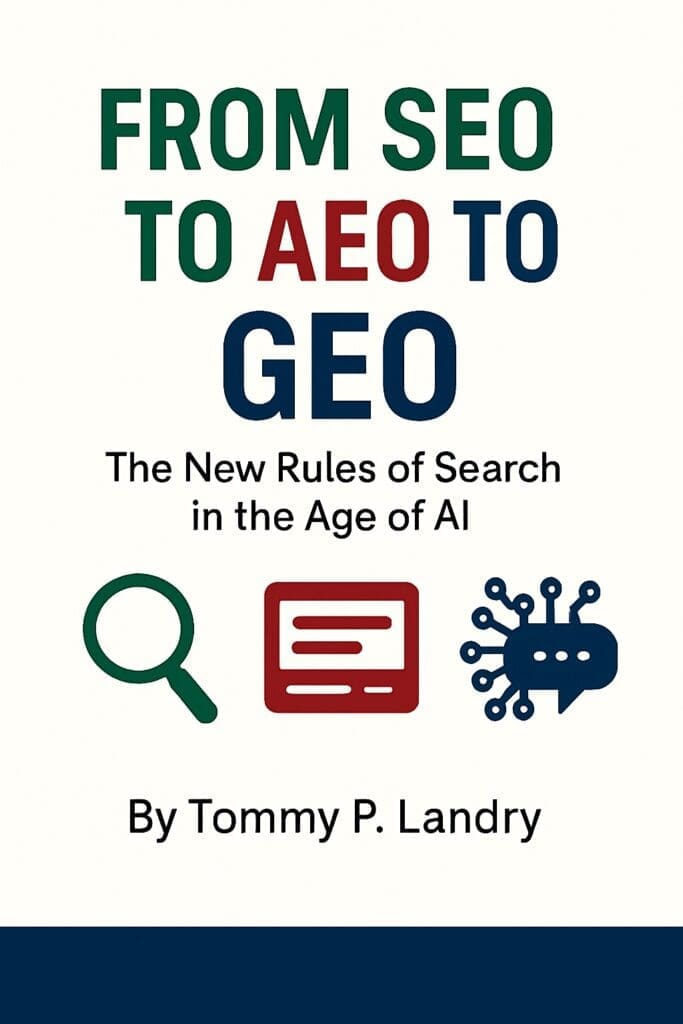
Pick up my book on Amazon as pictured here. This spells out all of the high lievel differences a well as a path forward for teams to embrace AI-based search and LLM visibility.
Frequently Asked Questions About Local SEO, AEO, GEO


Tommy Landry
Latest posts by Tommy Landry (see all)
- Do Press Releases Help AEO and GEO? The Real Value of AI Corroboration - September 14, 2026
- The HAIF Continuum: How Internal Data Becomes AI Representation - September 10, 2026
- The AI Marketing Signal Brief: AI Trust Now Depends on Control Points - August 28, 2026