TL;DR
Google AI Overviews have already served up fake customer support numbers that led users to scammers. This isn’t a glitch in rankings, no, it’s manipulation at the answer layer. I hate to label it as such, but this is Black Hat AEO.
If malicious actors can seed enough consistent misinformation across the web, AI systems will extract and summarize it as if it were legitimate. That makes AEO not just a growth strategy, but a brand protection issue for you and an identity security concern for your customers.
This Isn’t Hypothetical. It’s Already Happening.
If you’ve searched for a customer support number recently, you’ve probably seen Google’s AI-generated summary appear above the traditional blue links. It looks clean and feels authoritative. Most people would naturally assume that anything placed there has been verified.
That assumption is now risky.
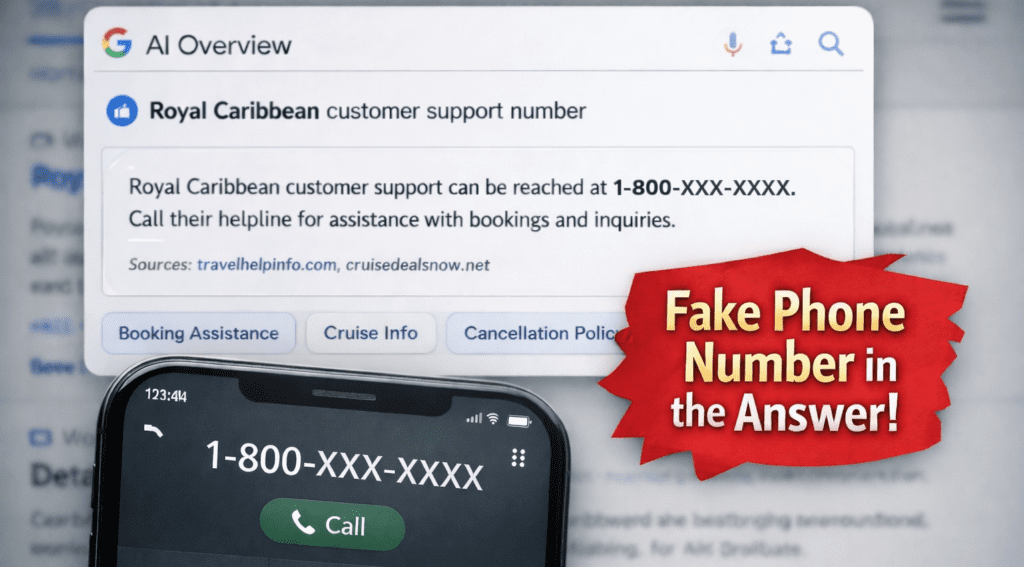
As of early 2026, there are confirmed cases where AI Overviews displayed fraudulent support numbers. In one instance, a user searching for shuttle booking information connected to Royal Caribbean was shown a fake phone number inside an AI summary. The caller reached a scammer instead of the cruise line and lost credit card information.
Similar reports have involved searches related to Southwest Airlines and British Airways, where fraudulent call centers impersonated official representatives after users dialed numbers surfaced in AI-generated results.
Now, imagine if they can do this with your bank, credit union, IRA administrator, or credit card provider. The potential damage could be almost limitless.
This is not about spam links buried on page three. This is about the answer box itself being fooled into showing fake information.
How the Manipulation Actually Works
To understand why this is happening, you have to look at how AI Overviews operate. Google aggregates information from across the web and generates a summarized response based on patterns and repetition it detects.
The system doesn’t independently verify a phone number the way a human investigator would. It looks for consistency across sources.
If malicious actors publish the same fake number across enough low-quality or compromised websites, that repetition can look like consensus to an automated model.
In this specific case, that repetition can serve as a proxy for credibility.
Instead of outranking an official site, scammers distribute false data widely enough that it becomes extractable. When Google’s AI scans and synthesizes what appears to be consistent information, it can elevate that number into the overview.
And because the output appears at the very top of the page, a lot of users will presume it’s the correct, valid contact information.
That’s the shift.
Traditional Black Hat SEO vs. Black Hat AEO
For years, Black Hat SEO manipulation centered on rankings. The goal was to capture position one and win clicks.
Now the battlefield has expanded.
| Traditional Black Hat SEO | Black Hat AEO |
| Manipulate rankings | Influence AI summaries |
| Compete for blue links | Compete for extraction |
| Traffic-focused | Answer-focused |
| Visibility via position | Visibility via synthesis |
You no longer have to rank if you can shape what the AI extracts. If malicious information becomes structured and widely distributed enough, it can surface in the answer itself.
That is why this matters.
Why This Is a Brand Protection Issue
If your business relies on phone-based support, booking systems, financial transactions, or sensitive customer interactions, this is not just a search marketing story.
It is a risk story.
You might have your correct phone number on your website, your Google Business Profile, and every major directory. That doesn’t guarantee it will be the number in an AI Overview, if the maliciously placed data spreads widely enough.
Most companies are not actively monitoring what AI systems say about them. That means a fraudulent number could circulate at the answer layer long before anyone internally notices.
AI visibility is no longer just about growth. It is also about defense, of your brand, reputation, and customer loyalty.
This Pattern Extends Beyond Financial Scams
Earlier AI Overview incidents included inaccurate health advice that was not malicious, but still potentially dangerous. The core structural issue is the same.
When a system compresses large amounts of web data into a single authoritative-looking summary, any errors or manipulations can be massive. This is because users assume prominence = verification.
That psychological dynamic is powerful.
When Google places information at the top of the page, people treat it as settled. As true. And as verified. See the problem here?
What You Should Do as a User
If you are searching for sensitive information, especially phone numbers tied to money or personal data, slow down.
- Go directly to the company’s official website (SEOs everywhere, rejoice!)
- Cross-check phone numbers across multiple trusted sources
- Be skeptical of urgency or immediate payment requests
- Consider adding “-ai” to reduce AI-generated summaries
A small amount of due diligence can help you avoid making a life-changing or devastating mistake.
What This Means for the Future of Search
Google has acknowledged these issues and is taking steps to remove known fake numbers while refining safeguards.
As with traditional search, I have full confidence that they’ll improve this situation sooner or later. But nonetheless, this structural reality isn’t going away in one fell swoop.
Search has already begun evolving to be more driven by “answers,” so we have a whole new attack surface to account for. These overviews are given prime real estate, so of course someone will want to take advantage of it.
I’ve spoken to many AI skeptics who have been expecting this for months or years. Looks like they were right.
Black hat SEO adapted over the years because incentives drove it, and Black Hat AEO is simply the next iteration of that same pattern.
If you work in search, marketing, or brand strategy, don’t treat AI Overviews as a novelty feature. You need to think about how your official data is distributed across the web, how consistent your entity signals are, and how quickly you would detect inaccurate information appearing in AI-generated answers.
Search didn’t just change format…it has changed the rules of trust.
Ready to get serious about owning what AI says about you? Contact us today for a no obligation consultation, and learn how we can help you stay ahead of this before it costs you customers.
Frequently Asked Questions About Black Hat AEO, GEO, and SEO


Tommy Landry
Latest posts by Tommy Landry (see all)
- Why AI-Generated Content at Scale Rises Fast, Then Falls Off a Cliff - March 27, 2026
- The Missing Link Between RevOps and AI Discoverability - March 12, 2026
- Black Hat AEO Is Here: Google AI Overview Manipulation Is Happening - February 24, 2026