B2B buyers have changed their behavior faster than most companies realized. Your prospects rely on AI tools to research problems, compare options, validate solutions, and reduce risk.
Those same buyers now expect clear answers, quick relevance, and credible sources.
Traditional Search Engine Optimization (SEO) alone cannot support that journey. You need a strategy that accounts for AI-shaped discovery across Google, AI Overviews, ChatGPT, Perplexity, and every other platform your buyers use.
B2B SEO in 2025 blends your core search strategy with AEO and GEO:
- Answer Engine Optimization (AEO) prepares your content and entity signals for AI answers inside Google.
- Generative Engine Optimization (GEO) prepares your brand for generative engines outside Google.
Both layers support your organic reach and shape your visibility at every step of the buyer’s journey.
This guide explains how B2B SEO works today, how AI curates your buyer’s research path, and how your company can earn visibility when AI models choose which brands to surface.
Why B2B SEO Now Requires AEO and GEO
Your buyers research with AI tools before they visit your website.
They ask broad questions. They ask specific questions.
They ask for comparisons, roadmaps, workflows, and recommendations.
And more often than not, they identify a short list of options before they run a single branded search.
You need visibility inside these AI-curated pathways or you lose the chance to influence the journey.
AI shapes the B2B information chain
Your prospects ask AI for:
- Vendor comparisons
- Implementation guidance
- Best practices
- Frameworks
- Integration ideas
- Industry examples
AI tools gather answers from trusted sources and summarize the most relevant insights.
Buyers trust what they see at this stage. You’ll earn more credibility when AI models surface your content early in the journey.
AI compresses the buyer journey
A buyer once needed ten steps to learn about your category. AI tools compress those steps into three.
Buyers move from problem awareness to solution design in minutes. It pays to provide content that matches every phase, so you can influence that progression proactively.
Your content must help buyers make decisions, not just discover keywords.
Entity clarity now drives visibility
AI tools treat your brand as an entity.
An entity includes your expertise, your product category, your audience, your industry presence, your relationships, and your credibility.
AI models track that information across:
- Your website
- Your case studies
- Your social presence
- Industry publications
- Customer feedback
- Linked sources
- Technical documentation
The clearer your entities are defined, the better your chances visibility inside AI summaries or AI-curated content will be.
How AI-Curated Buyer Journeys Work
AI tools use intent-based logic rather than keyword matching.
They interpret your buyer’s needs and connect those needs to the most relevant content.
You need to understand this flow to strengthen your position.
Buyers ask AI broad questions first
Prospects start with questions such as:
- What is the best way to solve this problem
- What frameworks guide this process
- Who offers solutions in this market
- What tools help with this workflow
AI provides answers to these queries as summaries, not lists. You need content that AI can trust at this point in the journey.
Buyers then ask for specificity
Your buyers next ask about:
- Pricing
- Integration
- Implementation
- Use cases
- ROI
- Industry relevance
AI tools surface detailed content at this stage. You need to serve them clear, structured, and direct answers that explain practical value without fluff.
Next, they seek validation
Your buyers want to see proof, asking for things such as:
- Case studies
- Comparisons
- Performance insights
- Templates or checklists
- Expert guidance
AI tools pull from your case studies, your whitepapers, your articles, and your thought leadership. It’s time to embrace and commit to clarity, structure, and context across all assets.
The New Pillars of B2B SEO in 2025
Your B2B SEO strategy depends on five core pillars that support visibility in AI-curated journeys.
Pillar 1: Entity-driven SEO
No matter what niche you operate in, you need to make sure your entities are exceptionally clear for search engines and LLMs alike. Your content must reinforce you:
- Markets
- Specialties
- Product features
- Audience
- Positioning
- Industry role
- Brand relationships
AI models reward clean and consistent entity signals. You can improve your visibility when every touchpoint reinforces the same identity.
Pillar 2: AEO readiness
AEO prepares your content for AI Overviews and other AI-driven search features inside Google.
Tactics that will help you position yourself for AEO success include:
- Clear answers
- Short paragraphs
- FAQ sections
- Schema markup
- Accurate product and service descriptions
- Clean topic structure
- Strong internal linking
AI Overviews rely on direct information. You can influence those answers when your content communicates with clarity.
Pillar 3: GEO strategy
GEO prepares your brand for generative AI platforms beyond Google, with tactics like:
- Strong topical coverage
- Clear frameworks
- Detailed explanations
- Honest comparison content
- Structured paragraphs
- Clean entity references
ChatGPT, Claude, Perplexity, and Gemini all choose content based on clarity and authority.
You will be able to earn citations when you produce content that answers questions without clutter.
Pillar 4: AI-assisted content depth
Your content needs depth that speaks to B2B buyers at multiple points. You need assets that cover:
- Industry examples
- Data-backed insights
- Practical next steps
- Integration advice
- ROI framing
- Operational workflows
AI tools surface content that feels complete and actionable. You will enjoy better visibility when your content helps buyers make informed decisions.
Pillar 5: Trust signals that B2B buyers value
B2B buyers seek confidence. They need proof that your team understands their world. Examples of formats that provide this information include:
- Case studies
- Analyst references
- Customer quotes
- Solution diagrams
- Architecture visuals
- Process documentation
AI tools draw from these trust signals. And similarly, buyers will trust you more when they see evidence of real experience.
How to Strengthen B2B Visibility Across SEO, AEO, and GEO
Your strategy needs a coordinated approach. You will be able to influence each layer through specific types of actions.
Action 1: Structure your content for AI interpretation
There are specific actions you can take with structuring your content for AI, such as:
- Clear H2 and H3 headers
- Short paragraphs
- FAQ sections
- Service pages with direct answers
- Schema for services and FAQs
- Internal links that reinforce key themes
You will gain a visibility advantage when AI can read your structure without friction.
Your content must cover your category from every angle, with content types like:
- Guides
- Frameworks
- Templates
- Comparisons
- Industry examples
- Point-of-view content
AI tools reward brands that show depth, so make sure you are providing what they desire.
Action 3: Strengthen your entity everywhere
Every mention of your brand must support the same identity. You need consistent:
- Titles
- Descriptions
- Categories
- Industry terms
- Product names
- Messaging themes
AI models trust brands with stable identities.
Action 4: Create content that supports decision stages
Your buyers move through stages quickly. You need content for:
- Early education
- Mid-funnel evaluation
- Late-funnel validation
AI tools will surface content that connects these stages. This is how you can win more attention with content that fulfills each step.
Action 5: Use AI as a research partner, not a writer
AI can help you:
- Identify patterns
- Discover missed topics
- Expand entities
- Validate intent
- Analyze competitors
AI helps you think. You should still retain control of important things like voice, clarity, and strategy.
Future Trends in B2B SEO
AI is here to stay, so it’s important to prepare for the next wave of AI-driven discovery.
AI will influence every major buyer decision
Your buyers already trust AI tools. They will rely on these tools more as models improve.
You will need to establish consistent visibility on LLMs and AI-based search if you want to earn their trust.
Entity strength will matter more than keywords
Keywords still matter, but entities will drive the future of B2B discoverability.
Strong entities are poised to outlast fluctuations in search features in the future.
GEO will rival Google as a discovery channel
Generative platforms will grow faster than search during the next few years.
I can’t stress enough how important it is to prioritize visibility inside these systems now.
B2B search journeys will continue to compress
AI will reduce research friction further. Be sure you are providing content that answers questions with speed and clarity.
Conclusion
Your B2B SEO strategy must evolve. We now compete in a world where AI tools shape every part of the buyer’s journey.
Your overall discoverability and visibility depend on strong entities, clear content, structured answers, and credible proof.
- SEO gives you a foundation.
- AEO improves your visibility inside Google’s AI experiences.
- GEO expands that visibility into every generative platform your buyers use.
You earn trust when you guide buyers with clear insights. And you win visibility when AI tools view your brand as the best source for answers.
You create momentum when all three layers support the same strategy.
Want to Learn More about Modern SEO/AEO/GEO?
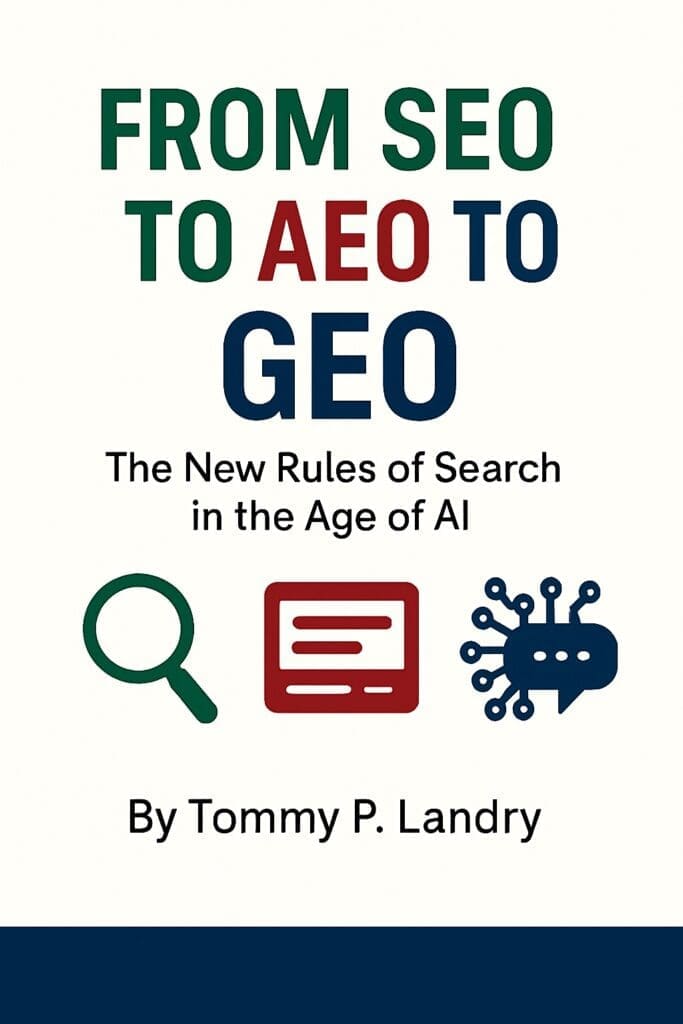
Pick up my book on Amazon as pictured here. This spells out all of the high lievel differences a well as a path forward for teams to embrace AI-based search and LLM visibility.
Frequently Asked Questions About B2B SEO


Tommy Landry
Latest posts by Tommy Landry (see all)
- Why AI-Generated Content at Scale Rises Fast, Then Falls Off a Cliff - March 27, 2026
- The Missing Link Between RevOps and AI Discoverability - March 12, 2026
- Black Hat AEO Is Here: Google AI Overview Manipulation Is Happening - February 24, 2026